Feldspar

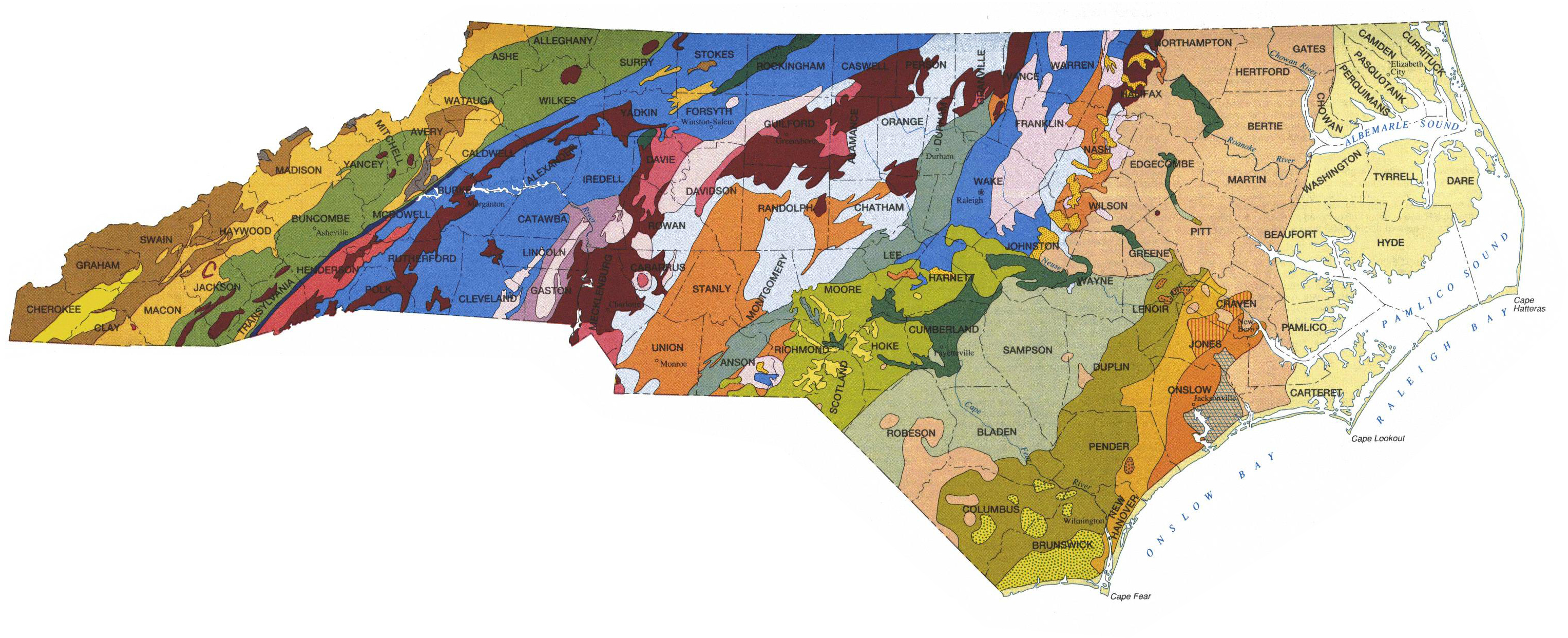
Feldspar is the most common rock forming mineral. Feldspar occurs in igneous, metamorphic and sedimentary rocks and thus can be found throughout the state. It is more commonly found in the Blue Ridge and Piedmont provinces. Feldspar is a common name that applies to a group of minerals with a general chemical formula of x Al(Al,Si)3O8, where x can be calcium (Ca) and/or sodium (Na) and/or potassium (K). Named compositional varieties are discussed under Mineral Descriptions. Feldspar weathers to kaolin which is the main clay mineral used in ceramics and fine pottery.

Map of Feldspar Resources - North Carolina

History and production

The history of feldspar production is directly tied to the history of mica production and past mining of kaolin in the Blue Ridge, since these are associated minerals. Evidence of early mica mining was reported by geologists in 1875 and 1876. They noted numerous prospect pits dotting the hillsides, some of which were very extensive in size with trees, 3 feet or more in diameter rooted on large spoil mounds next to the pits. Early known production extends back to the 18th century when it was said the Cherokee Indians mined and sold partially kaolinized feldspar prior to 1744, presumably for shipment to England for ceramic use. Feldspar was first mined along with kaolin (weathered feldspar) in an area near Sylva in Jackson County in the late 1800ís. Mining started in the Spruce Pine Mining District of Avery, Mitchell and Yancey counties in 1911. The raw material had to be shipped to grinding mills located in Ohio and New Jersey. In 1914, a grinding mill was built in Erwin, Tennessee and this led to the opening of more mines. Soon thereafter, North Carolina became the leading producer.

The initial production of feldspar was from pegmatite bodies. Pegmatites are bodies of rock commonly of granitic composition that consist mainly of unusually large crystals or masses of quartz, feldspar, and mica. Pegmatites crystallize during the last stages of emplacement of granitic igneous rocks. The magmatic fluids are rich in water and cool so slowly that the crystals grow larger than usual. The grain size can range from less than an inch to more than a foot and are rarely greater than 3 feet. Pegmatites range in size from small lenses, 1 to a few feet in thickness, to large tabular bodies tens of feet thick and hundreds of feet long. Past production came from the larger pegmatites. Mining was labor intensive. Ore was hand cobbed (hand-size pieces are broken by hammer) and sorted by hand. In 1946, the US Bureau of Mines developed a new mineral dressing technique to process mica and feldspar ore by froth flotation. In addition to the USBM work, North Carolina State Universityís Mineral Research Laboratory at Asheville has continued refine the technique on the ores of the district. This breakthrough turned attention away from the pegmatites and focused exploration and mining on the much larger more uniform alaskite bodies.

The Spruce Pine alaskite is a light colored, medium- to coarse-grained feldspar-quartz-muscovite rock that was emplaced as masses up to several miles in diameter. The average mineral composition of the alaskites is oligoclase feldspar (40%), quartz (25%), microcline feldspar (20%), and muscovite mica (15%). Alaskite also contains minor accessory minerals such as biotite, garnet, epidote, apatite and pyrite. In the Spruce Pine district, pegmatites are closely associated with the alaskite bodies and are thought to have crystallized from fluids derived from the alaskite masses in the final stages of crystallization of these igneous plutons.

Map of Feldspar Occurrences - Spruce Pine District

Other resources

Feldspar occurs in various types of granitic rock, particularly in the central portion of the state. Tests done on several granitic plutons have indicated that the Churchland pluton in central North Carolina in northern Rowan, Davie, Davidson, Guilford and Caswell Counties and the Rolesville granite in the Raleigh Belt in Wake and Franklin Counties contain high concentrations of potassium (K) feldspar.

Uses

Since 1916, North Carolina has been the leading producer of feldspar in the U.S. North Carolina presently (1997 data) produces 54% of the total US production. Most feldspar in North Carolina is produced from alaskite bodies in the Spruce Pine Mining District in Mitchell County. In recent years, feldspar has also been recovered from the Kings Mountain district as a by product of mining lithium (spodumene) from pegmatites, and as a by-product of mining mica from pegmatites and other rocks associated with the Cherryville quartz monzonite intrusive.

Feldspar is an important ingredient in the manufacture of glass and ceramics. The bulk of the raw material for glass consists of silica sand, soda ash (sodium carbonate) and limestone (calcium carbonate). Feldspar adds certain qualities to the process. Alumina contained in feldspar can provide hardness, strength, or make glass more resistant to chemicals. NaO2 and K2O are fluxes. Fluxes reduce the melting temperature so less energy is used. Sodium and potassium from feldspar decrease the amount of soda ash required to make glass.

Feldspar is mainly used in ceramics, especially in sinks and commodes. Feldspar serves as a flux to form a glassy phase at low temperatures, and as a source of alkalies and alumina in glazes. It is also used in paint and in mild abrasives.

Mineral properties

Feldspar is the most common rock forming mineral. Feldspar is a common name that applies to a group of minerals with a general chemical formula of x Al(Al,Si)3O8, where x can be one or more elements. Feldspar minerals are usually white or very light in color and have a hardness of 6 on the Mohs Scale of Hardness. Another physical property of the feldspar group is that the mineral has good cleavage. The cleavage breaks are at 90° for orthoclase and about 86° for plagioclase feldspars. Upon weathering feldspar minerals breakdown to form kaolinite, a clay mineral.

Feldspar minerals can be subdivided into two groups - plagioclase feldspars, and potassium feldspars. Plagioclase feldspars are sodium / calcium aluminum silicates. The suite of plagioclase feldspars are:

Potassium feldspars (potassium aluminum silicate). The most common K (potassium) feldspars are:

In the Spruce Pine District of Mitchell, Avery and Yancey counties there are over 700 mines recorded that produced feldspar and/or mica. There are probably 2 to 3 times as many prospects or borrow pits in the area. Listed below, in the occurrence section in the mineral descriptions, are a few collecting sites in Mitchell County and one in Yancey County that are relatively safe and easy to get to in these counties.


MINERAL DESCRIPTIONS

Plagioclase feldspars

Albite (moonstone)
Chemical
Composition
(Na,Ca)AlSi3O8, Sodium, calcium (0 to 10%) aluminum silicate.
Class Silicate
Crystallography Triclinic; pinacoidal
Habit Crystals commonly tabular. Usually massive, granular, lamellar. Twinning very common.
Physical
properties
Cleavage {001} perfect, {010} nearly perfect, {110} imperfect. Fracture uneven
to conchoidal. Brittle. H. 6-6.5. S.G. 2.6-2.63. Luster vitreous, sometimes pearly.
Color white to colorless; occasionally bluish, gray, reddish, greenish depending on
impurities. May have play of opalescent colors (moonstone). Streak white. Transparent
to sub-transparent.

Map of Feldspar Mineral Localities

Mineral localities and descriptions of localities are from Wilson and McKenzie (1978) and Conley (1958). These locations have not been field checked for accuracy, minerals present or for accessibility. The site code (e.g. AVERY-002) refers to the site reference in the Mineral Locality Index.

Occurrences

Albite is a very common mineral of the plagioclase group.

Avery County The May-Meade quarry (closed) along with epidote, chlorite, tremolite, calcite, thulite, azurite, malachite, and green quartz crystals (AVERY-003).
Caswell County Albite has been found in the pegmatite deposits south of Milton near Yarbro (CASWE-001).
Cleveland County High-quality moonstone has been found in the alluvium of several creeks in the west central portion of the county (CLEVE-001, CLEVE-002, CLEVE-003). Albite occurs at the Foote Mineral Company spodumene mine (closed) near Kings Mountain (CLEVE-013).
Davie County Fine grained albite is associated with hornblende in an orbicular diorite rock in the south central portion of the county (DAVIE-003). The rock was once used as an ornamental stone.
Mitchell County The Spruce Mine Mining District is one of the chief mica- and feldspar-producing areas in the United States.

Feldspar, plagioclase, quartz and mica (muscovite) occurs at the McKinney mine (fee charged) (MITCH-015). Other accessory minerals that occur are samarskite, garnet, autunite, torbernite, columbite, hyalite, amazonite, bornite, covellite, chalcopyrite, allanite, epidote, malachite, sphalerite and massive beryl. To get to the mine take Highway 19-E west from Estatoe, at 1.3 miles turn left (south) on SR 1002, at approximately 4.8 miles turn on to SR 1100. The mine is on both sides of the road (now Emerald Village and the North Carolina Mining Museum).

Feldspar, plagioclase, perthite, quartz and muscovite mica can be found at the Hootowl mine (abandoned) (MITCH-017). This mine can be reached by taking Highway 19-E west from Estatoe, at 0.37 mile turn left (south) on SR 1157, at 0.4 mile take the right fork, at approximately 0.9 mile the state road ends and a private road begins. The mine is on the left (east) side of the road. The Hootowl is shown and labeled on the Micaville 7.5 minute topographic map.

Feldspar, plagioclase, quartz and muscovite mica along with accessory minerals biotite, garnet and tourmaline (rare) are reported from the Sinkhole mine (abandoned) (MITCH-016). This mine can be reached by going 1.6 miles northwest from the intersection of SR 1191 and NC Highway 226 on SR 1191, turn left on Highway 80, at 2.3 miles the mine is to the left just before SR 1182. This mine is shown on the Micaville 7.5 minute topographic map.

Another collecting locale is at the Deer Park mine (abandoned) (MITCH-008) northwest of Spruce Pine. Feldspar, perthite, plagioclase, quartz and mica can be found with accessory minerals thulite, hyalite and monazite. At the intersection of NC Highway 226 and SR 1162, north of Spruce Pine, turn left (southwest) on to SR 1162 (Penland Road). Travel approximately 1.6 miles to Penland and cross bridge over the North Toe River. Turn immediately left (east) on to SR 1270 for a very short distance. After state maintained road ends continue on unmaintained 4-wheel drive road that parallels the river to the mine area in bend of the North Toe River approximately 0.7 of a mile. This mine is shown on the Spruce Pine 7.5 topographic map.

Rare doubly terminated albite crystals in a pegmatite dike on private property 1.5 miles northeast of Bakersville (MITCH-004).
Yancey County Feldspar (plagioclase), perthite, quartz and muscovite occur at the Ray (Wray) mica mine (abandoned) (YANCE-001). Other minerals reported are golden and aquamarine beryl, apatite crystals, clear oligoclase (plagioclase feldspar), amazonite, thulite, garnet, autunite, columbite-tantalite, tourmaline, zircon and rutile. To reach this mine turn south on to NC Highway 197 from US Highway 19-E in Burnsville. Travel 0.9 mile to an intersection with SR 1109. Turn left (east) and travel along SR 1109 (Bowlens Creek Road) for approximately 1.4 miles to the intersection with SR 1192, nearly opposite the Bowlens Creek Church. Turn left (east) on to SR 1192 for about 0.3 mile where the state maintained road ends and a 4-wheel drive road leads to mine workings a little further ahead on left. This site lies in the Pisgah National Forest.

Oligoclase
Chemical
Composition
(Na,Ca)AlSi3O8, Sodium, calcium (10 to 30%) aluminum silicate.
Class Silicate
Crystallography Triclinic; pinacoidal
Habit Crystals commonly tabular, uncommon. Usually massive, cleavable, granular, or
compact. Twinning common.
Physical
properties
Cleavage {001} perfect, {010} nearly perfect, {110} imperfect. Fracture conchoidal
to uneven. Brittle. H. 6-6.5. S.G. 2.63-2.67. Luster vitreous. Colorless, white,
gray, greenish, yellowish, brown, reddish, depending on impurities; occasionally shows
brilliant reflections from inclusions of hematite giving it a golden shimmer (sunstone).
Streak white. Transparent to translucent.

Map of Feldspar Mineral Localities

Mineral localities and descriptions of localities are from Wilson and McKenzie (1978) and Conley (1958). These locations have not been field checked for accuracy, minerals present or for accessibility. The site code (e.g. AVERY-002) refers to the site reference in the Mineral Locality Index.

Occurrences

Oligoclase occurs in the Spruce Pine District in western North Carolina and is a very common mineral in granites and gneisses.

Jackson County Oligoclase occurs at the L.M. McCall feldspar and mica mine southeast of Pinhook Gap (JACKS-010).
Mitchell County The Spruce Mine Mining District is one of the chief mica- and feldspar-producing areas in the United States. Feldspar, quartz and mica (muscovite) occurs at the McKinney mine (fee charged) (MITCH-015). Other accessory minerals that occur are samarskite, garnet, autunite, torbernite, columbite, hyalite, amazonite, bornite, covellite, chalcopyrite, allanite, epidote, malachite, sphalerite and massive beryl. To get to the mine take Highway 19-E west from Estatoe, at 1.3 miles turn left (south) on SR 1002, at approximately 4.8 miles turn on to SR 1100. The mine is on both sides of the road (now Emerald Village and the North Carolina Mining Museum).

Feldspar, plagioclase, perthite, quartz and muscovite mica can be found at the Hootowl mine (abandoned) (MITCH-017). This mine can be reached by taking Highway 19-E west from Estatoe, at 0.37 mile turn left (south) on SR 1157, at 0.4 mile take the right fork, at approximately 0.9 mile the state road ends and a private road begins. The mine is on the left (east) side of the road. The Hootowl is shown and labeled on the Micaville 7.5 minute topographic map.

Feldspar, plagioclase, quartz and muscovite mica along with accessory minerals biotite, garnet and tourmaline (rare) are reported from the Sinkhole mine (abandoned) (MITCH-016). This mine can be reached by going 1.6 miles northwest from the intersection of SR 1191 and NC Highway 226 on SR 1191, turn left on Highway 80, at 2.3 miles the mine is to the left just before SR 1182. This mine is shown on the Micaville 7.5 minute topographic map.

Another collecting locale is at the Deer Park mine (abandoned) (MITCH-008) northwest of Spruce Pine. Feldspar, perthite, plagioclase, quartz and mica can be found with accessory minerals thulite, hyalite and monazite. At the intersection of NC Highway 226 and SR 1162, north of Spruce Pine, turn left (southwest) on to SR 1162 (Penland Road). Travel approximately 1.6 miles to Penland and cross bridge over the North Toe River. Turn immediately left (east) on to SR 1270 for a very short distance. After state maintained road ends continue on unmaintained 4-wheel drive road that parallels the river to the mine area in bend of the North Toe River approximately 0.7 of a mile. This mine is shown on the Spruce Pine 7.5 topographic map.

Glass-clear oligoclase at the Hawk mine located 1.2 miles north of Hawk (MITCH-005).
Yancey County The Spruce Pine Pegmatite District crosses eastern Yancey County east of Burnsville. The Little Gibbs mine on the South Toe River 1.5 miles northeast of Celo contains glass-clear oligoclase feldspar which can be cut into faceted gem stones (YANCE-009).

Feldspar (plagioclase), perthite, quartz and muscovite occur at the Ray (Wray) mica mine (abandoned) (YANCE-001). Other minerals reported are golden and aquamarine beryl, apatite crystals, clear oligoclase (plagioclase feldspar), amazonite, thulite, garnet, autunite, columbite-tantalite, tourmaline, zircon and rutile. To reach this mine turn south on to NC Highway 197 from US Highway 19-E in Burnsville. Travel 0.9 mile to an intersection with SR 1109. Turn left (east) and travel along SR 1109 (Bowlens Creek Road) for approximately 1.4 miles to the intersection with SR 1192, nearly opposite the Bowlens Creek Church. Turn left (east) on to SR 1192 for about 0.3 mile where the state maintained road ends and a 4-wheel drive road leads to mine workings a little further ahead on left. This site lies in the Pisgah National Forest.
Anorthite
Chemical
Composition
CaAl2Si2O8, Calcium aluminum silicate.
Class Silicate
Crystallography Triclinic; pinacoidal
Habit Usually massive, cleavable, granular, or compact.
Physical
properties
Cleavage two perfect {010,001} at 86°. Fracture uneven to conchoidal.
Brittle. H. 6. S.G. 2.74-2.76. Luster vitreous. Color white-gray, reddish.
Transparent to translucent.

Map of Feldspar Mineral Localities

Mineral localities and descriptions of localities are from Wilson and McKenzie (1978) and Conley (1958). These locations have not been field checked for accuracy, minerals present or for accessibility. The site code (e.g. AVERY-002) refers to the site reference in the Mineral Locality Index.

Occurrences

Anorthite occurs in some ultramafic igneous rocks.

Clay County Anorthite occurs in a dunite deposit located on Buck Creek, north of US 64 (CLAY-009).

Potassium feldspars

Microcline
Chemical
Composition
KAlSi3O8, Potassium aluminum silicate
Class Silicate
Crystallography Triclinic; pinacoidal
Habit Crystals often short prismatic. Twinning may be present. Often massive,
coarsely cleavable to granular.
Physical
properties
Cleavage {001}, {010} perfect at nearly right angles (89.5° ). Fracture
uneven. Brittle. H. 6-6.5. S.G. 2.56-2.63. Luster vitreous, sometimes pearly on
cleavage surfaces. Color white, gray, pale cream-yellow, flesh-pink, various shades
of red, green (amazonstone). Streak uncolored to white. Transparent to translucent.

Map of Feldspar Mineral Localities

Mineral localities and descriptions of localities are from Wilson and McKenzie (1978) and Conley (1958). These locations have not been field checked for accuracy, minerals present or for accessibility. The site code (e.g. AVERY-002) refers to the site reference in the Mineral Locality Index.

Occurrences

Microcline occurs in granites, granitic gneisses and pegmatites.

Caswell County Microcline can be found in the pegmatite bodies south of Milton near Yarbro. A 10-12 foot wide pegmatite dike crops out (exposed) in a road cut on the north side of SR 1554, 0.35 mile northwest of its intersection with SR1557 and contains nearly perfect crystals of microcline (CASWE-001). A 5-7 foot wide pegmatite crops out on the east side of SR 1559, 0.4 mile southeast of Semora. The pegmatite is composed of intergrowths of quartz, microcline feldspar, and muscovite mica. The quartz occurs as irregularly shaped masses surrounded by subhedral to euhedral microcline feldspar and grayish to clear crystals of muscovite mica (CASWE-002).
Cleveland County Microcline is one of the many minerals that can be found at the Foote Mineral Company spodumeme mine near Kings Mountain (CLEVE-013).
Harnett County Pink microcline occurs in small pegmatites at Raven Rock (an exposure of metamorphic rock) on the southwest bank of the Cape Fear River northwest of Lillington and east of Raven Rock Church (HARNE-002). Raven Rock is now part of the North Carolina Park System which prohibits the collecting of mineral specimens.
Henderson County Microcline occurs in a pegmatites in the area around Tuxedo. Three of these localities are, the Freeman mine, 0.5 mile west of Tuxedo on SR 1118 (HENDE-001); the Jones mine, 0.5 mile east of Tuxedo on SR 1856 (HENDE-002); and the Pace mine, 1.8 miles southwest of Tuxedo (HENDE-003).
Mitchell County Amazonite, a green microcline, can be found at the McKinney mine (fee charged) (MITCH-015) along with feldspar, quartz and mica (muscovite). Other accessory minerals that occur are samarskite, garnet, autunite, torbernite, columbite, hyalite, amazonite, bornite, covellite, chalcopyrite, allanite, epidote, malachite, sphalerite and massive beryl. To get to the mine take Highway 19-E west from Estatoe, at 1.3 miles turn left (south) on SR 1002, at approximately 4.8 miles turn on to SR 1100. The mine is on both sides of the road (now Emerald Village and the North Carolina Mining Museum).

Feldspar, plagioclase, quartz and muscovite mica along with accessory minerals biotite, garnet and tourmaline (rare) are reported from the Sinkhole mine (abandoned) (MITCH-016). This mine can be reached by going 1.6 miles northwest from the intersection of SR 1191 and NC Highway 226 on SR 1191, turn left on Highway 80, at 2.3 miles the mine is to the left just before SR 1182. This mine is shown on the Micaville 7.5 minute topographic map.

Another collecting locale is at the Deer Park mine (abandoned) (MITCH-008) northwest of Spruce Pine. Feldspar, perthite, plagioclase, quartz and mica can be found with accessory minerals thulite, hyalite and monazite. At the intersection of NC Highway 226 and SR 1162, north of Spruce Pine, turn left (southwest) on to SR 1162 (Penland Road). Travel approximately 1.6 miles to Penland and cross bridge over the North Toe River. Turn immediately left (east) on to SR 1270 for a very short distance. After state maintained road ends continue on unmaintained 4-wheel drive road that parallels the river to the mine area in bend of the North Toe River approximately 0.7 of a mile. This mine is shown on the Spruce Pine 7.5 topographic map.
Yancey County Feldspar (plagioclase), perthite, quartz and muscovite occur at the Ray (Wray) mica mine (abandoned) (YANCE-001). Other minerals reported are golden and aquamarine beryl, apatite crystals, clear oligoclase (plagioclase feldspar), amazonite, thulite, garnet, autunite, columbite-tantalite, tourmaline, zircon and rutile. To reach this mine turn south on to NC Highway 197 from US Highway 19-E in Burnsville. Travel 0.9 mile to an intersection with SR 1109. Turn left (east) and travel along SR 1109 (Bowlens Creek Road) for approximately 1.4 miles to the intersection with SR 1192, nearly opposite the Bowlens Creek Church. Turn left (east) on to SR 1192 for about 0.3 mile where the state maintained road ends and a 4-wheel drive road leads to mine workings a little further ahead on left. This site lies in the Pisgah National Forest.

Orthoclase
Chemical
Composition
KAlSi3O8, Potassium aluminum silicate.
Class Silicate
Crystallography Monoclinic; prismatic
Habit Crystals often short prismatic. Twinning may be present. Often massive,
coarsely cleavable to granular.
Physical
properties
Cleavage {001}, {010} perfect at right angles (90° ). Fracture uneven to
conchoidal. Brittle. H. 6-6.5. S.G. 2.55-2.63. Luster vitreous. Colorless, white,
gray, pale yellow, pink, flesh-red. Streak colorless to white. Transparent to translucent.

Map of Feldspar Mineral Localities

Mineral localities and descriptions of localities are from Wilson and McKenzie (1978) and Conley (1958). These locations have not been field checked for accuracy, minerals present or for accessibility. The site code (e.g. AVERY-002) refers to the site reference in the Mineral Locality Index.

Occurrences

Orthoclase occurs in granites, granitic gneisses and pegmatites.

Davidson County Orthoclase has been identified at the Silver Hill mine 5 miles southeast of Lexington (DAVID-003), as a gangue (part of a mineral assemblage that is not economic but must be mined to retrieve valuable ore).
Granville County At the Holloway mine located 2 miles south and 1 mile west of Virgilina the northwestern portion of the county (GRANV-003). Copper was mined here in the late 1800ís and for short periods in the early 1900ís. Orthoclase feldspar is a gangue mineral associated with the copper ore.
Harnett County Orthoclase occurs in small pegmatites at Raven Rock (an exposure of metamorphic rock) on the southwest bank of the Cape Fear River northwest of Lillington and east of Raven Rock Church (HARNE-002). Raven Rock is now part of the North Carolina Park System which prohibits the collecting of mineral specimens.
Mitchell County The Spruce Mine Mining District is one of the chief mica- and feldspar-producing areas in the United States.

Feldspar, plagioclase, quartz and mica (muscovite) occurs at the McKinney mine (fee charged) (MITCH-015). Other accessory minerals that occur are samarskite, garnet, autunite, torbernite, columbite, hyalite, amazonite, bornite, covellite, chalcopyrite, allanite, epidote, malachite, sphalerite and massive beryl. To get to the mine take Highway 19-E west from Estatoe, at 1.3 miles turn left (south) on SR 1002, at approximately 4.8 miles turn on to SR 1100. The mine is on both sides of the road (now Emerald Village and the North Carolina Mining Museum).

Feldspar, plagioclase, perthite, quartz and muscovite mica can be found at the Hootowl mine (abandoned) (MITCH-017). This mine can be reached by taking Highway 19-E west from Estatoe, at 0.37 mile turn left (south) on SR 1157, at 0.4 mile take the right fork, at approximately 0.9 mile the state road ends and a private road begins. The mine is on the left (east) side of the road. The Hootowl is shown and labeled on the Micaville 7.5 minute topographic map.

Feldspar, plagioclase, quartz and muscovite mica along with accessory minerals biotite, garnet and tourmaline (rare) are reported from the Sinkhole mine (abandoned) (MITCH-016). This mine can be reached by going 1.6 miles northwest from the intersection of SR 1191 and NC Highway 226 on SR 1191, turn left on Highway 80, at 2.3 miles the mine is to the left just before SR 1182. This mine is shown on the Micaville 7.5 minute topographic map.

Another collecting locale is at the Deer Park mine (abandoned) (MITCH-008) northwest of Spruce Pine. Feldspar, perthite, plagioclase, quartz and mica can be found with accessory minerals thulite, hyalite and monazite. At the intersection of NC Highway 226 and SR 1162, north of Spruce Pine, turn left (southwest) on to SR 1162 (Penland Road). Travel approximately 1.6 miles to Penland and cross bridge over the North Toe River. Turn immediately left (east) on to SR 1270 for a very short distance. After state maintained road ends continue on unmaintained 4-wheel drive road that parallels the river to the mine area in bend of the North Toe River approximately 0.7 of a mile. This mine is shown on the Spruce Pine 7.5 topographic map.

Pink orthoclase occurs at the Southers Branch(?) mine located 1.7 miles northwest of Spruce Pine (MITCH-009). Orthoclase feldspar which can give a sunstone sheen is found on the McKinney property, which lies at the end of SR 1159, 0.5 mile east of NC Highway 261, 2.4 miles northeast of Glen Ayers (MITCH-003).
Rare doubly terminated orthoclase crystals in a pegmatite dike on private property 1.5 miles northeast of Bakersville (MITCH-004).
Yancey County Feldspar, plagioclase, perthite, quartz and muscovite occur at the Ray (Wray) mica mine (abandoned) (YANCE-001). Other minerals reported are golden and aquamarine beryl, apatite crystals, clear oligoclase (plagioclase feldspar), amazonite, thulite, garnet, autunite, columbite-tantalite, tourmaline, zircon and rutile. To reach this mine turn south on to NC Highway 197 from US Highway 19-E in Burnsville. Travel 0.9 mile to an intersection with SR 1109. Turn left (east) and travel along SR 1109 (Bowlens Creek Road) for approximately 1.4 miles to the intersection with SR 1192, nearly opposite the Bowlens Creek Church. Turn left (east) on to SR 1192 for about 0.3 mile where the state maintained road ends and a 4-wheel drive road leads to mine workings a little further ahead on left. This site lies in the Pisgah National Forest.

Further Reading

The text was developed using the following references. See these for further information.

Carpenter, R.H., Schlanz, J.W. and Carpenter, P.A., III, 1995, Potential feldspar resources in north-central North Carolina: North Carolina Dept. of Environment, Health and Natural Resources, North Carolina Geol. Sur., Open-File Report 95-1, 21 p.

Carr, D.D. and others, eds., 1994, Industrial Minerals and Rocks (6th edition): Littleton, Colo., Soc. for Mining, Metallurgy, and Exploration, Inc., 1196 p.

Conley, J.F., 1958, Mineral localities of North Carolina: North Carolina Dept. of Natural and Economic Resources, Div. of Earth Resources, Geology and Mineral Resources Section, Information Circular 16, 128 p.

Cook, R.B., 1978, Minerals of Georgia, their properties and occurrences: Georgia Dept. of Natural Resources, Geology and Water Resources Div., Bull. 92, 189 p.

Gaines, R.V., Skinner, H.C.W., Foord, E.E., Mason, B., Rosenzweig, A. 1997, Dana's New Mineralogy: the System of mineralogy of James Dwight Dana and Edward Salisbury Dana, 8th edition: John Wiley and Sons, New York, 1819 p.

Lesure, F.G., 1968, Mica deposits of the Blue Ridge in North Carolina: U.S. Geol. Sur. Prof. Paper 577, 129 p.

Paris, T.A., 1994, Minerals of Tennessee: privately printed, 240 p.

Potter, M.J., 1996, Feldspar and Nepheline Syenite: Minerals Yearbook, US Dept. of Interior, US Geological Survey; (//minerals.er.usgs.gov/minerals).

Potter, M.J., 1997, Feldspar: Mineral Commodity Summaries, US Dept. of Interior, US Geological Survey; (//minerals.er.usgs.gov/minerals).

Reid, J.C., Carpenter, R.H. and Davis, T.E., 1998, Permitted active and inactive mining operations in North Carolina as of June, 1998: North Carolina Dept. of Environment. and Natural Resources, Open-File Report, in preparation.

Stuckey, J.L., 1965, North Carolina: Its geology and mineral resources: North Carolina Div. of Mineral Resources, 550 p.

U.S. Geological Survey Database, 1997, Minerals Availability System/Mineral Information Locality (MAS/MIL) Database: U.S. Geol. Sur.; (//minerals.er.usgs.gov/minerals).

Wiener, L.S. and Merschat, C.E., 1977, Field Guidebook to the geology of the central Blue Ridge of North Carolina and the Spruce Pine Mining District: Assoc. of Amer. State Geologists, Ann. Meeting, May 1975, Asheville, North Carolina, North Carolina Dept. of Natural and Economic Resources, Div. of Earth Resources, Geology and Mineral Resource Sec., 24 p.

Wilson, W.F. and McKenzie, B.J., 1978, Mineral collecting sites in North Carolina: North Carolina Dept. of Natural Resources and Community Development, Geol. Sur. Sec., Information Circular 24, 122 p.


Back to Mineral ResourcesBack to NCGS Home