“ROCKHOUNDING”
Note: The following is from the U.S.
National Forest flyer whose title appears below.
All telephone numbers were verified as of November 9, 2000. The Eastern
States Office’s address, Bureau of Land Management, was also updated
November 9, 2000. This provides general information on “Rockhounding” on
National Forest Land. Contacts are provided for additional information.
A
“Rockhound” is a person who hunts and collects rocks and minerals as a
hobby.
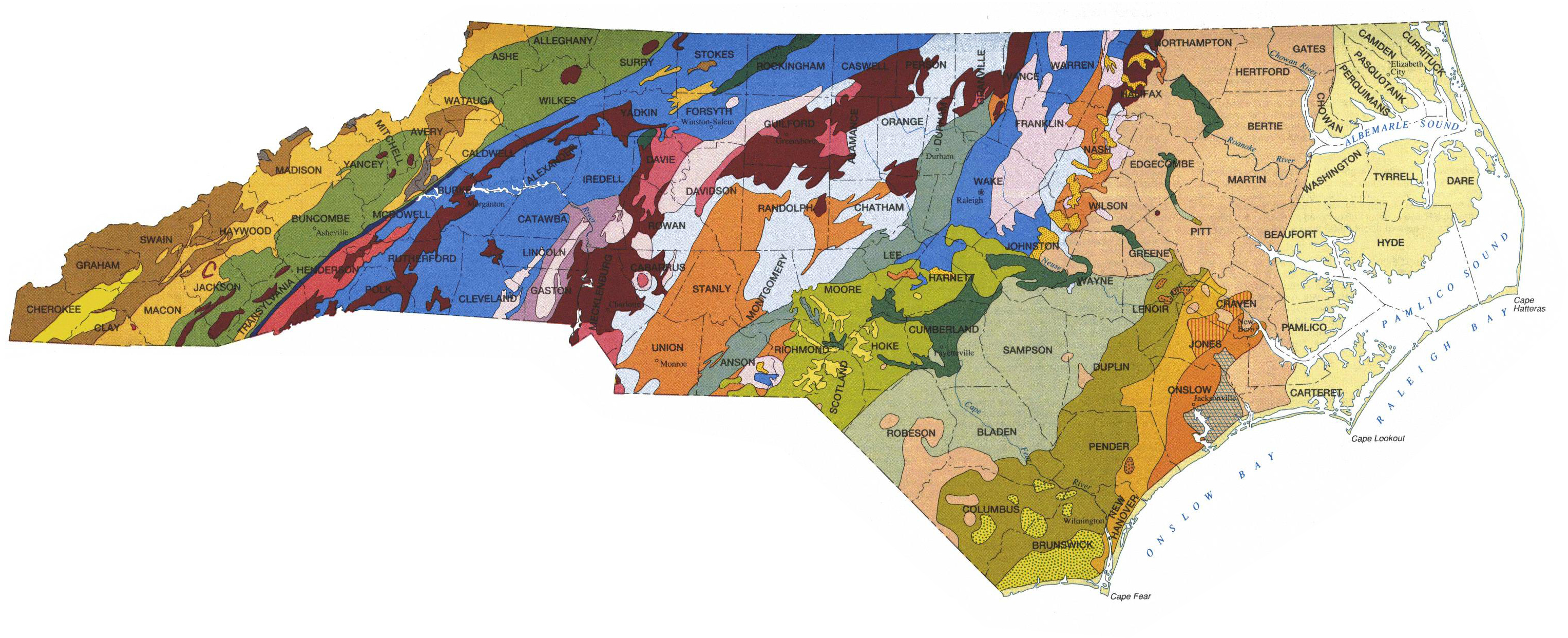
A wide variety of igneous, sedimentary and metamorphic
rock types are found within the National Forests in North Carolina, and many
individual minerals are found in association with these rocks.
As a rule, there is no objection to taking a handful of
rock, mineral, or petrified wood specimens from the surface of the National
Forest System lands. No fee,
special permission, or permit is required as long as:
The specimens are for personal, non-commercial use
collection does not conflict with existing mineral permits, leases, claims, or sales.
There are many areas scattered throughout the Forests
where the United States owns the surface of the land, but does not own the
minerals. There is no objection
to collecting specimens of the local rock types exposed on the surface;
however, mineral specimens that may have some value can only be collected with
permission from the mineral owner(s). These
may be identified from maps in offices of the Forest Supervisor and District
Rangers.
Rockhounding must not be confused with commercial
mineral activities. Mining
and mineral leasing laws are applicable to all activities of a commercial
nature. During the course of
collecting rock and mineral specimens, the rockhound may feel that an area is
worthy of detailed exploration to determine whether or not a mineral is
present in commercial quality and quantity.
This type of detailed exploration can be conducted only under a Forest
Service or Bureau of Land Management (BLM) Permit.
Applications and additional information may be obtained from: Eastern
States Office, BLM, 7450 Boston Boulevard, Springfield, Virginia 22153.
Certain areas are designated as archeological sites or
geologic interest areas. Ground
disturbance of any sort is prohibited in these protected areas.
Unrecorded archeological sites are also protected areas.
Included with rockhounding is panning for gold in
the beds of many streams crossing National Forest land. Stream-bed (placer) gold, in most cases, does not exist in
sufficient quantity to constitute economically recoverable deposits.
Ordinarily, no more than a few cents worth of gold can be panned per
hour; however, there is always a chance of finding that stray nugget or odd
pocket of finer gold. No fee,
special permission or permit is required as long as only shovel and pan
techniques are employed and no significant stream disturbance results, but one
should first check with the local District Ranger.
On National Forest land, where the minerals are privately owned,
panners should obtain written permission from the mineral owner(s) prior to
beginning collection.
In the National Forests in North Carolina, recreational
suction dredging is not allowed. A
closure order was signed by the Forest Supervisor on September 14, 1993.
In relation to mineral activities, disturbance is considered significant when:
Natural recovery would not be expected to take
place within a reasonable period of time.
There is unacceptable air or water degradation.
There is unnecessary or unreasonable injury, loss or damage to National Forest resources, i.e., use of explosives or mechanical equipment.
Additional details helping to define “significant disturbance” can be found in the Forest Service Manual (FSM) 2817.11, Code of Federal Regulations (36FR) 228.4 and at the offices of each District Ranger.
Collectors and panners are advised to contact Forest Service offices about access to National Forest lands. Some areas may be readily accessible by family auto, while others may be accessible only with difficulty by four-wheel-drive vehicles or hiking. Some roads may be seasonally closed. Remote areas may be accessible only by foot.
Forest Service District Ranger Offices are the best sources for on-the-ground information relating to local access, road conditions, and rest/picnic/scenic areas, camping, swimming, hunting, fishing, etc. These offices are open Monday through Friday, usually between 8:00 A. M. to 4:30 P. M. They are closed Saturdays and Sundays. Maps identifying National Forest land are available at the offices of the Forest Supervisor and the District Ranger. Forest Service offices do not normally keep information on all minerals or collecting localities but may be knowledgeable of some areas. The best sources for such information are state geological survey offices, university geology departments and libraries, mineralogical societies, rockhounding and lapidary clubs, etc.
The Forest Service obtains authority for managing “rockhounding” from 43 CFR 3560.7 (Hardrock Mineral Specimen Collection), Final Rules-Federal Register, April 22, 1986, Page 15250.
For further information contact:
Supervisor’s Office, National Forests in North
Carolina, 160A Zillicoa Street, Asheville, North Carolina 28802-2750.
Telephone: 828-257-4200
Cheoah Ranger District, Robbinsville NC 28771.
Telephone: 828-479-6431
French Broad Ranger District, Hot Springs, NC 28743.
Telephone: 828-622-3202
Appalachian Ranger District, Burnsville, NC 28714. Telephone: 828-682-6146
Uwharrie Ranger District, Troy, NC 27371. Telephone: 919-576-6391
Croatan Ranger District, New Bern, NC 28560. Telephone: 919-638-5628
Grandfather Ranger District, Marion, NC 28752. Telephone: 828-652-2144
Pisgah Ranger District, Pisgah Forest, NC 28768. Telephone: 828-877-3265
Tusquitee Ranger District, Murphy, NC 28906. Telephone: 828-837-5152
Wayah Ranger District, Franklin, NC 28734. Telephone: 828-524-6441