Mineral
Resources
- This page answers many questions
commonly asked of NC Geological Survey staff
geologists. For more information, please call us
at (919) 733-2423, or write to us at NC
Geological Survey, Division of Land Resources,
1612 Mail Service Center, Raleigh, NC 27699-1612.
In addition to responses to frequently asked
questions, a summary of the state's geology is
provided to accompany the home page graphic, as
well as a summary of mineral production and
industrial minerals. Our e-mail address is: jeff.reid@ncmail.net
-
- Frequently
asked questions
- North Carolina's official state
precious stone is the emerald.
- North Carolina's official state
rock is granite.
- There is no official state fossil
for North Carolina.
- North Carolina leads the nation in
the production of feldspar, mica and
pyrophyllite.
- Mining is a half-billion dollar
industry in North Carolina.
- North Carolina's Mount Mitchell is
the highest point east of the Mississippi River.
Its elevation is 6,684 feet above sea level.
- The largest emerald crystal ever
found in North America came from North Carolina.
- In 1823, North Carolina became the
first state to fund a geological and
mineralogical survey.
- North Carolina is divided into
three physiographic provinces: Blue Ridge,
Piedmont and Coastal Plain.
- North Carolina's geology
represents more than a billion years of constant
change.
- What are minerals? - Minerals are
naturally occurring elements or compounds. Each
mineral has its own crystal and chemical makeup
and physical qualities such as hardness and
color. Rocks are made up of minerals.
- Types of rocks - There are three
different kinds of rocks, depending on how they
were formed. Igneous rocks formed when melted
rock cooled and hardened. Sedimentary rocks
formed in layers from bits of older rocks and
parts of animals or plants. These collect in low
areas or under water and harden into rocks.
Metamorphic rocks formed when either sedimentary,
igneous, or earlier formed metamorphic rocks were
put under pressure and heat deep in the earth's
crust.
-
- The state rock
- The General Assembly of 1979
designated granite as the official State rock.
North Carolina is blessed with an abundance of
granite. When granite is crushed, it is used as
an aggregate for road and building construction.
If granite has the right physical properties, it
can be cut into blocks and used for monuments,
curbstone and stone for building facings. The
largest open-face granite quarry in the world is
located at Mount Airy, North Carolina.
- The State
Precious Stone - Emerald
- The General Assembly of 1973
designated the emerald as the official State
precious stone Emerald is found in North Carolina
near Hiddenite in Alexander County and southwest
of Spruce Pine in Mitchell County. The largest
single emerald crystal found in North America was
found at the Rist Mine at Hiddenite in 1969. The
crystal weighed 1,438 carats. The "Carolina
Emerald," a 13.14 carat emerald-cut gem, was
also found at the Rist Mine.
-
- The highest
point in North Carolina
- The highest point in North
Carolina (and the highest point east of the
Mississippi River) is Mount Mitchell. Its
elevation is 6,684 feet.
-
- What minerals
are produced in North Carolina?
- North Carolina has important
deposits of many minerals and annually leads the
nation in the production of feldspar, lithium
minerals, scrap mica, olivine and pyrophyllite.
The State ranks second in phosphate rock
production. North Carolina does not produce
significant quantities of metallic minerals.
North Carolina does not have oil or gas
production.
-
- Geology and
Mining - Down to Earth Facts
- Consumer products that come from
North Carolina's geologic resources:
- Brick - Brick manufacturing
is the third largest mining industry in North
Carolina. Clay is mined and made into bricks of
all shapes, colors and sizes. Bricks are also
used for large buildings and in the paving of
walkways. Some clays are made into drain and
floor tiles.
- Dimension and building stone
- Many buildings, including the Sate Capitol, are
covered by North Carolina dimension stone. One of
the most popular is the Mount Airy granite.
Dimension stone is also used to face or veneer
buildings, walls and fireplaces.
- Gemstones - Emeralds,
rubies, garnets and more than 300 other varieties
of gemstones can be found in North Carolina.
Thousands of tourists and rockhounds search for
gemstones in North Carolina each year.
- Gold - North Carolina was
once a major gold producing state. In 1788, a
17-pound nugget was discovered in Cabarras
County. That discovery touched off the first true
gold rush in the United States. During the
mid-1800's gold coins were minted at the
privately owned Bechtler Mint in Rutherford
County and a branch of the United States Mint in
Charlotte. Although large-scale gold production
ended in the 1800's; gold production continued
until 1942. New mining technology has renewed
interest in commercial gold production.
- Crushed stone (aggregate) -
The crushed rock, sand and gravel used to build
roads comes from North Carolina's largest income
producing mining industry. Without it, we could
not build roads of concrete or asphalt or
construct bridges. Large stones, called riprap,
are often used on steep slopes to help hold the
soil in place, preventing erosion and
sedimentation.
- Kaolin clay - Kaolin clay
is used in the manufacture of dinnerware, fine
porcelain and as a paper coating.
- Olivine - Furnaces used to
bake bricks are lined with olivine. Olivine is
used as a refectory liner in kilns and heating
furnaces.
- Quartz and feldspar -
Refined quartz and feldspar components are used
in television picture tubes. Quartz of high
purity is used in computer components. The large Palomar telescope mirror in California was made
from North Carolina quartz. Feldspar is also used
in bath tiles, abrasives in cleaners and roofing
shingles.
- Peat - Peat is mixed with
soil around plants and flowers. Peat is also used
as an insulation for packing fruits and
vegetables and as a protein additive in cattle
food.
- Phosphate - Phosphate is
used in plant food, fertilizers, animal feed,
pesticides, ceramics and photography.
- Silica sand and quartz -
Silica sand and quartz mined in North Carolina
are used in the manufacture of glass. Refined
silica sand is also used in the glass screens of
televisions and computers and in the electronic
chips.
- Spodumene - Lithium is
produced from spodumene. Lithium is used in
supersonic aircraft, spacecraft, paints,
batteries, grease, lubricants, photography and
medicine.
- Talc and pyrophyllite -
Talc is used in paints, insecticides, rubber
products, ceramics, paper coatings and
dinnerware. Pyrophyllite is used in soaps,
bleaching powders, and electrical insulators. The
most familiar use for both minerals is in talcum
powder.
-
- Physiography
- North Carolina can be divided into
three physiographic provinces: the Coastal Plain,
the Piedmont and the Blue Ridge. Each province is
characterized by particular types of landforms.
- The Coastal Plain is characterized
by flat land to gently rolling hills and valleys.
Elevations range from sea level near the coast to
about 600 feet in the Sand Hills of the southern
inner Coastal Plain.
- The Piedmont Province lies between
the Coastal Plain and the Blue Ridge Mountains.
The Piedmont occupies about 45 percent of the
area of the state. Along the border between the
Piedmont and the Coastal Plain, elevations range
from 300 to 600 feet above sea level. To the
west, elevations gradually rise to about 1,500
feet above sea level at the foot of the Blue
Ridge. The Piedmont is characterized by gently
rolling, well rounded hills and long low ridges
with a few feet of elevation difference between
the hills and valleys. The Piedmont includes some
relatively low mountains including the South
Mountain and the Uwharrie Mountains.
- The Blue Ridge is a deeply
dissected mountainous area of numerous steep
mountain ridges, intermontane basins and trench
valleys that interect at all angles and give the
area its rugged mountain character. The Blue
Ridge contains the highest elevations and the
most rugged topography in the Appalachian
Mountain system of eastern North America. The
North Carolina portion of the Blue Ridge is about
200 miles long and ranges from 15 to 55 miles
wide. It contains an area of about 6,000 square
miles, or about 10 percent of the area of the
state.
- Within North Carolina, 43 peaks
exceed 6,000 feet in elevation and 82 peaks are
between 5,000 and 6,000 feet. On the west, the
Great Smoky Mountains is the dominant range with
several peaks that reach more than 6,000 feet. On
the eastern side of the North Carolina Blue
Ridge, the highest range is the Black Mountains
which extend for some 15 miles and contain a
dozen peaks that exceed 6,000 feet in elevation.
This group includes Mount Mitchell. At an
elevation of 6,684 feet in elevation, it is the
highest peak of eastern North America. Other
prominent ranges from northeast to southwest are
the Pisgah Mountains, Newfound Mountains, Balsam
Mountains, Nantahala Mountians, and the Valley
River Mountains.
-
- General
geology of North Carolina
- Three major classes of rocks
common to North Carolina are igneous, metamorphic
and sedimentary. North Carolina has a long and
complex history. Although much remains to be
learned, detailed geologic studies provide a
general understanding of regional geological
relationships. The State is best described in
terms of geological belts; that is, areas with
similar rock types and geologic history.
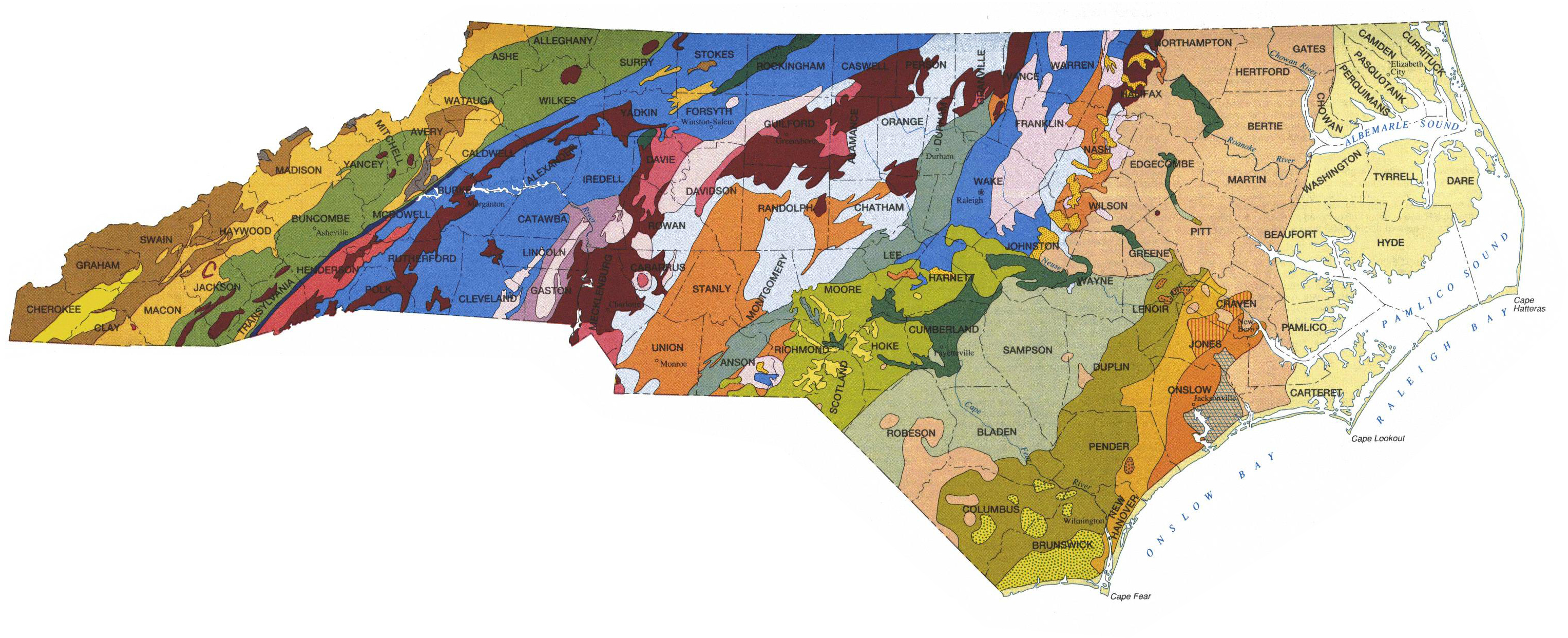
- The following discusses geologic
belts shown in color on the NCGS's home page. A
printed generalized geologic map (11" x
17") is available at nomininal charge.
- Blue Ridge Belt - This
mountainous region is composed of rocks from over
one billion to about one-half billion years old.
This complex mixture of igneous, sedimentary and
metamorphic rock has been repeatedly squeezed,
fractured, faulted and folded. The Blue Ridge
belt is well known for its deposits of feldspar,
mica and quartz-basic materials used in the
ceramic, paint and electronic industries. Olivine
is mined for use as a refactory material and
foundry molding sand.
- Inner Piedmont Belt - The
Inner Piedmont Belt is the most intensely
deformed and metamorphosed segment of the
Piedmont. The metamorphic rocks range from 500 to
750 milllion years in age. They include gneiss
and schist that have been intruded by younger
granitic rocks. The northeast-trending Brevard
fault zone forms much of the boundary between the
Blue Ridge and the Inner Piedmont belts. Although
this zone of strongly deformed rocks is one of
the major structural features in the southern
Appalachians, its origin is poorly understood.
Crushed stone for road aggregate and building
construction is the principal commodity produced.
- Kings Mountain Belt - The
belt consists of moderately deformed and
metamorphosed volcanic and sedimentary rocks. The
rocks are about 400-500 million years old.
Lithium deposits here provide raw materials for
chemical compounds, ceramics, glass, greases,
batteries and television glass.
- Milton Belt - This belt
consists of gneisses, schist and metamorphosed
intrusive rocks. The principal mineral resource
is crushed stone forroad aggregate and buidlings.
- Charlotte Belt -The belt
consists mostly of igneous rocks such as granite,
diorite and gabbro. These are 300-500 million
years old. The igneous rocks are good sources for
crushed and dimension stone for road aggregate
and buildings.
- Carolina Slate Belt - This
belt consists of heated and deformed volcanic and
sedimentary rocks. It was the site of a series of
oceanic volcanic islands abou 550-650 million
years ago. The belt is known for its numerous
abandoned gold mines and prospects. North
Carolina led the nation in gold production before
the California Gold Rush of 1849. In recent
decades, only monor gold mining has taken place,
but mining companies continue to show interest in
the area. Mineral production is crushed stone for
road aggregate and pyrophyllite for refactories,
ceramics, filler, paint and insecticide carriers.
- Triassic basins - The basins are
filled with sedimentary rocks that formed about
190-200 million years ago. Streams carried mud,
silt, sand and gravel from adjacent highlands in
rift valleys similar to those of Africa today.
The mudstones are mined and processed to make
brick, sewer pipe, structural tile and drain
pipe.
- Raleigh belt - The Raleigh
belt contains granite, gneiss and schist. In the
19th century there were a number of small
building stone quarries in this region, but today
the main mineral product is crushed stone for
construction and road aggregate.
- Eastern Slate Belt - This
belt contains slightly metamorphosed volcanic and
sedimentary rocks similar to those of the
Carolina slate belt. The rocks are poorly exposed
and partially covered by the Coastal Plain
sediments.The metamorphic rocks, 500-600 million
years old, are intruded by younger, approximately
300 million-year-old, granitic bodies. Gold was
once mined in the belt, and small occurrances of
molybdenite, and ore of molybdenum, have been
prospected here. Crushed stone, clay, sand and
gravel are currently mined in this belt.
- Coastal Plain - The Coastal
Plain is a wedge of mostly marine sedimentary
rocks that gradually thickens to the east. The
Coastal Plain is the largest belt in the State
covering 45 percent of the land area. The most
common sediment types are sand and clay, although
a significant amount of limestone occurs in the
southern part of the Coastal Plain. In the
Coastal Plain, geology is best understood from
studying data gathered from well drilling. The
State's most important mineral resource in terms
of dollar value is phosphate, an important
fertilizer component, mined near Aurora, Beaufort
County. Industrial sand for making container and
flat glass and ferrosilicon and used for
filtration and sandblasting is mined in the
Sandhills area.
-
- North
Carolina, U.S.A.: An Industrial Mineral
Storehouse
- The following material was taken
from Carpenter, P.A., III, Reid, Jeffrey C., and
Gardner, Charles H., 1995, North Carolina,
U.S.A.: An industrial mineral storehouse, in
Brian J. Walker, editor, Claudette M. Simard,
compiler, Proceedings of the 28th Symposium on
Industrial Minerals, May 3-8, 1992, Martinsburg,
West Virginia, USA, West Virginia Geologic and
Economic Circular C-46, p. 65-70. Copies of the
complete paper including maps and figures, and
references are available from the authors upon
request. Use of this material should be
accompanied by appropriate citation.
- ABSTRACT
- North Carolina's varied and
complex geology is reflected in the diversity of
its mineral industry. Although no metallic
minerals are mined presently, North Carolina has
a long-established industrial minerals industry.
North Carolina leads the nation in the production
of feldspar, lithium minerals, scrap mica,
olivine, and pyrophillite, and also leads in the
production of clay used for brick manufacture.
The state ranks second in phosphate rock
production. Additional production is from crushed
stone, sand and gravel, dimension stone, kaolin,
peat and gem stones. Recently discovered heavy
mineral deposits will be produced in the near
future. Typically North Carolina's annual mineral
production is over $500 million dollars.
- INTRODUCTION
- North Carolina's varied and
complex geology is reflected in the diversity of
its mineral industry. Although metallic no
metallic minerals are presently mined, the long
established production of a variety of industrial
minerals allows the state to maintain a position
in the top 21 mineral producers by value in the
nation. Typically, North Carolina's annual
mineral production exceeds $500 million dollars.
- Lithium minerals, phosphate rock,
and crushed stone account for the bulk of the
annual mineral production. North Carolina leads
the nation in the production of feldspar, lithium
minerals, scrap mica, olivine and pyrophyllite.
The state leads the nation in the production of
clay used for brick manufacture and ranks seconds
in phosphate rock production. North Carolina does
not produce significant quantities of metallic
minerals but has potential resources.
- Industrial minerals are mined
thoughout North Carolina in the Mountain,
Piedmont and Coastal Plain provinces. Sand and
gravel are mined in about half the counties and a
variety of igneous and metamorphic rocks are
quarried in many Mountain and Piedmont counties
for the production of crushed stone and dimension
stone. The Coastal Plain has a few limestone
quarries which produce crushed stone and
agricultural limestone.
- INDUSTRIAL MINERALS
- Clay - Common
clays suitable for the manufacture of brick and
tile products are found throughout the Coastal
Plain, Piedmont, and Mountain Provinces. These
clays provide the raw materials for the
manufacture of bricks. North Carolina is annually
the nation's leader in brick production. Mines in
the the central Piedmont obtain clays from
weathered slate belt rocks. In Lee and Moore
counties, clays are mined from Triassic
sediments. In addition to face brick, other major
uses for clay are for lightweight aggregate,
cement, common brick, sewer pipe, and to a lesser
extent, structural, drain tile, and glazed tile.
Kaolin is recovered as a byproduct of feldspar
and mica benficiation in Avery and Cleveland
counties.
- Crushed stone -
For many years, crushed stone has been the
leading mineral commodity by value in the state.
Annually, it accounts for almost one-half of the
total mineral production value. Leading counties
in the production of crushed stone are Wake,
Mecklenburg, Gilford, Forsyth, and Buncombe. The
top five companies produce over 80 percent of the
tonnage. These companies are Martin Marietta
Aggregates Company, Nello L. Teer Company
(Beazer, USA), Vulcan Materials Company, and Wake
Stone Corporation.
- Granite and related crystalline
rocks in the Piedmont and Blue Ridge geologic
belts provide the principle sources of crushed
stone in North Carolina. Other quarries are
located in the dense fine-grained rocks of the
Carolina Slate belt. Crystalline limestone and
marble are quarried, in limited amounts, in the
Piedmont and Mountain regions. Shell limestone
from the Castle Hayne and River Bend formations
and the Rocky Point Member of the Peedee
Formation are the primary sources of crushed
stone in the Coastal Plain.
- Dimension stone -
Most dimension stone in North Carolina is
produced from granite, agrillite, quartzite,
marble, and sandstone. The North Carolina Granite
Company operates one of the largest granite
dimension stone quarries in the world at Mt. Airy
in Surry County. The Mount Airy granite ia a
light-colored biotie granitoid (monzogranite).
The rock is used as street curbing, ashlar for
masonry walls, rubble, rip-rap, monuments, and
sawed blocks for buildings. Dimension granite is
also quarried in Rowan County from light-colored
gray to pink granite of the Salisbury pluton.
This granite is used for foundations,
street-curbing, paving, and monuments. Dark
bluish-gray argillite (Mudstone Member of the Cid
Formation) is quarried by Jacobs Creek Stone
Company from slate belt rocks in Montgomery and
Davidson counties. This stone's smooth, natural
cleavage allows it to be used extensively in
flooring, stair treds, borders, and window sills.
Marble is quarried near Murphy as market
conditions dictate. A variety of rocks, such as
metasandstone, quartzite, phyllite, and other
metamorphic rocks are quarried in the Blue Ridge
and Piedmont for dimension stone uses.
- Sand and gravel - Sand and gravel
for construction purposes are mined in about half
the counties in North Carolina. The Sandhills
region in Anson, Moore, Lee, Harnett, and
Richmond counties is the principle producing
area. Much of the sand is obtained from the
Pinehurst Formation. Gravel is mined from the
overlying terrace gravels. Material from this
area is shipped to many parts of the state and to
South Carolina. In western North Carolina,
Buncombe County is the largest producer of sand
and gravel. Most sand is used for concrete
aggregate, asphaltic concrete, and fill.
- Industrial sand is mined primarily
in Anson and Richmond counties in the Sandhills
region. Additional tonnages are also obtained
during feldspar and lithium beneficiation in the
Spruce Pine and Kings Mountain areas. Most of the
sand is used in the container and flat-glass
industries and also for ferrosilicon, filtration,
sandblasting, and traction industries.
- Feldspar -
Feldspar was first mined in North Carolina in
1911 in the Spruce Pine district, the main
feldspar-producing district in North America.
Original mining was from pegmatite bodies but
current mining is from alaskite,a very
coarse-grained, light-colored,
feldspar-quartz-muscovite rock. Composition of
the rocks averages about 40 percent plagioclase
(soda-spar), 25 percent quartz, 20 percent
microcline (potash-spar), and 15 percent
muscovite. The alaskite is processed using a
three-stage acid circut floation. By-product mica
and silica are also recovered. Most of the
production is from mines in Mitchell County, but
companies in the Kings Mountain-Cherryville area
recover a feldspar-silica concentrate during mica
and lithium beneficiation.
- Feldspar production has decreased
each year since reaching a record high $15.5
million in 1986. The U.S. feldspar producers
receive strong competition from Canadian
producers of nepheline syenite. Nepheline syenite
is used for many of the same purposes as
feldspar.
- The main uses of feldspar are in
whiteware, tile, and glass fiber insulation.
Feldspar is used both in the body of the ware and
the glaze of ceramics.
- Mica - Mica
mining began on a large scale in western North
Carolina about 1868. The area has become the most
important producer of mica in the U.S. Sheet mica
was the principal product for many years, but
other materials have eliminated many of the uses
for sheet mica. Consequently, North Carolina has
not produced significant amounts of sheet mica
since about 1962. Scrap mica is still produced in
large quantities. Primary sources are alaskite
and pegmatites.
- North Carolina annually leads the
nation in the production of scrap mica, producing
about 60 percent of the total. Primary production
is from Mitchell County in the Spruce Pine
district, and in Cleveland County in the Kings
Mountain district. Mica is produced as a
coproduct of feldspar, silica, and kaolin mining
and as a byproduct of lithium mining.
- Both wet- and dry-ground products
are produced. Dry-ground mica is used primarily
in the manufacture of gypsum plasterboard joint
cement, wall board, and well-drilling muds.
Wet-ground mica is used in cosmetics, paint, and
plastic manufacture.
- Lithium -
Although first recognized as early as 1906, the
economic significance of the spodumen-bearing
pegmatites of the Kings Mountain district was not
realized until 1942. Today, this relatively small
area in Cleveland and Gaston counties contains
more than 80 percent of the known lithium ore
reserves in the U.S. Estimated proved and
probable reserves of 70 million short tons of 20
percent spodumene or 1.5 percent Li2O.
- The lithium-bearing pegmatites
crop out along a 1-mile-wide zone on the west
flank of the Kings Mountain Shear zone. This
shear zone separates high-grade metamorphic rocks
of the Inner Piedmont on the west from lower
grade metamorphic rocks of the Kings Mountain
belt on the east. The pegmatites contain
approximately 20 percent spodumene, 32 percent
quartz, 27 percent albite, 14 percent microcline,
and 6 percent muscovite. The pegmatite zone was
originally referred to as the tin-spodumene belt
because cassiterite occurs in some pegmatites in
this same zone.
- Spodumene is mined to produce
lithium carbonate, lithium metal, and chemical
compounds. Lithium is also used to manufacture of
ceramics, glass, greases, TV glass, and
batteries. In recent years, increased foreign
production of lithium carbonate has resulted in
temporary closings at several of the mines.
- Olivine - Olivine
occurs as isolated dunite bodies, or alpine-type
peridotites, in the Blue Ridge. Two main
districts, the Webster-Balsam district in Jackson
County and the Spruce Pine district in Yancey and
Mitchell counties, have produced most of the
olivine. The deposits contian 50 to 90 percent
olivine. Vermiculite and anthophyllite asbestos
also occur in the same rocks as the olivine and
have been mined in the past. North Carolina leads
the nation in olivine production, although
production is presently limited to the Daybrook
Mine near Burnsville in Yancey County.
- Olivine is a magnesium silicate
used principally as a refactory. It is becoming
increasingly important as a molding sand in the
foundry industry. Olivine is being studied for
heat-storage blocks for heat-storage furnaces.
- Olivine production has declined in
recent years because of a decline in steel
production and because of increased competition
from olivine imports.
- Phosphate - In
the late 1950's a phosphate deposit was found
beneath a large portion of Beaufort County in the
Miocene Pungo River Formation. Subsequent
exploration deliniated a minable ore body that
contained about 2 billion tons of phosphate ore.
North Carolina is now the second-leading
phosphate producer behind Florida. About 95
percent of the total United States phosphate
production comes from North Carolina and Florida.
- Phosphate is produced by Potash
Corporation of Saskatchewan who purchased the
assets of Texasgulf, Incorporated in 1985.
Phosphate production is from the large open-pit
Lee Creek mine located near Aurora in Beaufort
County. The major portion of the output from this
mine is used in nearby chemical facilities to
produce phosphoric acid, triple superphosphate,
and diammmonium phosphate. In 1985, Texasgulf,
Incorporated, purchased North Carolina Phosphate
Corporation (NCPC). NCPC was developing a mine
and plant near the Texasgulf operation.
- Deposits of phosphorite also occur
off North Carolina's coast in the northeast
Onslow Bay district and the Frying Pan Shoals
district. The lower part of the Pliocene Yorktown
Formation contains phosphorite in the Aurora
phosphate district and represents a potential
resource. Further exploration may lead to
production from these deposits.
- Pyrophyllite and talc
- Pyrophyllite is a high alumina mineral that, in
North Carolina, occurs exclusively within
hydrothermally altered felsic volcanic rocks of
the Carolina Slate belt. The mineral was first
mined commercially in North Carolina in 1855 and
has been mined almost continuously since that
time. Pyrophyllite is mined near Robbins and
Glendon in Moore County and at Hillsborough in
Orange County. Major uses for the pyrophyllite
are in the refactory, ceramic, paint, and
insecticide industries and as a joint compound
filler. The Orange County deposit contains
andalusite in addition to pyrophyllite. Other
pyrophyllite deposts in the slate belt have been
mined and prospected and may provide additional
reserves.
- Talc deposits are associated with
the white, siliceous, dolomitic Murphy Marble in
Cherokee and Swain counties. These deposits were
mined as early as 1859 but are currently
inactive.
- Heavy minerals -
Deposits of heavy minerals, including ilmenite,
rutile, and zircon have been discovered in the
upper Coastal Plain of North Carolina. Total
reserves are estimated at 25 million shorttons of
heavy minerals. In North Carolina, the deposits
are located in Wilson, Nash, and Halifax
counties. Southeast Tisand is evaluating a
deposit for possible development near Roanoke
Rapids, and RGC (USA) Minerals, Inc. is
evaluating deposits in the Aurelian Springs and
Bailey areas.
- Gemstones - North
Carolina has long been famous for the variety of
precious and semi-precious stones found in the
Piedmont and Mountain regions of the state.
Several dozen commercially operated collecting
localities are open to the public. Amateur
collectors seach for emeralds, rubies, sapphires,
hiddenite, garnet, and other semi-precious
stones. North Carolina ranks first in the east in
the mining and marketing of gemstones and mineral
speciments.
- The main gem-collecting counties
are Alexander (emeralds and hiddenite), Macon
(rubies, sapphires, and garnets), and Mitchell
(emeralds and aquamarine).
- Other non-metallic
minerals - Additional minerals may
eventually be discovered in economic quantities
in North Carolina. Monazite, a mineral that
contains rare-earth elements, was once mined in
the western Piedmont, and occurrences are also
known in the eastern Piedmont. Monazite,
ilmenite, and rutile may occur with other heavy
minerals offshore.
- Diamonds - The
source of 13 diamonds found in North Carolina
during the mid- to late-1800's has never been
determined. Recent NCGS research on lamproites in
the Charlotte area may provide clues to the
source of these diamonds and for diamond
prospecting in other areas of the Piedmont.
- MINERAL FUELS
- Mineral fuels provide the primary
sources of energy currently consumed in the
world. They include coal, petroleum, natural gas,
and uranium. North Carolina is deficient in the
mineral fuels and must import these resources
from outside sources in order to meet its energy
requirements.
- Coal - Only one
area in North Carolina is known to contain coal
beds of potential commercial importance. This
area is the Deep River coal field which lies
along the Deep River in Chatham, Moore, and Lee
counties. The coal field is in the Deep River
Triassic Basin and occupies a zone of about 35
miles long and 5 to 10 miles wide. Its center
lies about 10 miles northwest of Sanford, North
Carolina.
- The medium volatile bituminous
coal occurs in beds in the Cumnock Formation. It
is associated with shales, siltstones, and
sandstone. Coal beds in the Cumnock range from a
few inches to 48 inches thick. The Cumnock and
the Carolina coal mines produced coal from this
seam intermittently from 1854 to 1953.
- There were three important periods
of coal production in the Deep River coal field.
The first was from 1861 to 1873 during, and as a
result of, the Civil War. The second period was
from 1889 to 1905, when the Cumnock Mine was the
only producer. The third was from 1918 to 1930,
when both the Cumnock and Carolina Mines were
open. During 1949 approximately 14,000 tons of
coal were produced from the Carolina mine.
However, because the coal seam is deeply buried
and badly broken by numerous dissecting faults,
production in the Deep River area ceased in 1953.
- It is estimated that 110,337,000
tons of steam and coking coal exists. However,
because of faulting in the area, less than half
of this coal might be mined. In order to recover
a large quantity of coal from this area, much
subsurface structural geologic mapping and
drilling must be done to determine the locations
of faulted coal seams.
- Peat - Fuel-grade
peat deposits cover about 677,000 acres in
Coastal North Carolina. Total reserves are about
500 million tons of moisture-free peat. These
deposts formed in the past 10,000 years in swamps
or pocosins, Carolina bays, and river flood
plains. Most of the peat occurs at the surface
with no overburden. The peat ranges from 1 to 15
feet thick and averages 4.5 feet thick. The
largest deposits are in the Albemarle-Pamlico
peninsula and the Dismal swamp. Many
environmental concerns must be faced before these
environmentally sensitive areas can be mined.
Production, to date, has been for use in
agricultural products such as soil conditioners
and potting soil. Other uses of peat include as a
heat source, a feed stock for synthetic
compounds, a waste treatment material, and as a
filter material.
- Petroleum and natural gas
- Approximately 125 exploratory oil and gas wells
have been drilled in North Carolina since the
first one was drilled in 1925. Most have been in
the outer Coastal Plain. Traces of oil and gas
have been detected in a few of these wells but no
producing wells have been developed.
- Several areas in North Carolina
are considered to have potential to produce oil
and gas. The main area is the outer Coastal
Plain. It contains a relatively thick pile of
sedimentary rocks including some excellent trap
or reservoir rocks, but source rocks may not be
present.
- Seismic surveys in the Blue Ridge
suggest that sedimentary rocks are deep beneath
the crystalline rocks. These sediments may be
similar to oil- and gas-bearing sediments in the
Valley and Ridge Province. Detailed studies have
not been conducted to verify the seismic surveys.
- The Triassic basins have received
attention from oil and gas exploration companies
during recent years. Excellent source rocks are
present, but the sandstones are not permeable.
Fine-grained material fills pore spaces between
the sand grains, preventing the migration of
hydrocarbons. The Cumnock and Gulf coal beds have
been studies for possible in-situ methane gas
generation.
- Mobil Oil Corporation proposed to
drill for natural gas of the Atlantic shelf off
the North Carolina coast.
- Uranium minerals
- A number of the uranium-bearing minerals occur
as minor constituents in the pegmatites of North
Carolina. These pegmatites are principally in the
Spruce Pine district and adjacent areas.
Radioactive minerals have found in schists and
underlying granitic rocks in northern Burke,
Mitchell, Avery, and adjacent counties. However,
it is not likely that any of these occurrences is
large enough to be of commercial value. Trace
amounts of uniformly distributed uranium are
associated with the phosphate deposits of
Beaufort County.
- In 1982 Marine Uranium Corporation
announced the discovery of a 30-million-ton
uranium ore body in Pittsylvania County,
Virginia. The ore body was in augen gneiss
adjacent to the Chatham Fault, along the west
side of the Danville Triassic basin. Because of a
drop in uranium ore prices and local opposition
to the project, these deposits were not
developed. Similar rocks farther south in
Rockingham County, North Carolina, were also
explored.
- METALLIC MINERALS
- Metallic minerals are associated
principally with the igneous and metamorphic
rocks of the Piedmont and Blue Ridge geologic
belts. Ores of chromium, copper, gold and silver,
iron, lead and zinc, manganese, molybdenum,
nickel, tin, titanium, and tungsten all occur in
either the Piedmont or Mountain Provinces.
- Although of little importance in
the state's mining industry today, gold, copper,
iron, and tungsten were produced in the past.
During the 1950's, the Hamme Mine in Vance County
was the largest tungsten mine in the U.S. The
mine was reopened as the Tungsten Queen Mine for
a short time about 1970 but closed in the fall of
1971 because of declining tungsten prices.
Considerable reserves of tungsten remain at the
site.
- North Carolina was the nation's
leading gold producer prior to the 1849
discoveries in California. Because of its
geologic similarity to important metal mining
districts in Canada, the Carolina Slate Belt has
been an area of extensive exploration. It is
considered a good site for the discovery of base
metal deposits (copper, lead and zinc) and gold
associated with ancient hot-spring systems. The
use of heap-leaching methods to recover gold from
low-grade ore has revive interest in the slate
belt. The recent development of four mines in
South Carolina has encouraged continued
exploration in similar geologic settings in North
Carolina.
- HOME