|
This section provides examples about effects of Hurricanes Frances
and Ivan in September 2004 in western North Carolina; scroll down for more information.
|
| Landslide Information On This Site:
|
Landslide presentation
The following images were included in a MS PowerPoint presentation
used by North Carolina Geological Survey geologists from the Asheville Regional
Office at many public landslide outreach meetings. The presentation
has been adapted to the Internet for broader distribution. This page
is on "Hurricanes Frances and Ivan -- September 2004." Links
to other topics appear in the contents shown above.
Slide numbers correspond to those of the original MS PowerPoint presentation.
Slide numbers "missing" are slides that were turned into text.
Captions are from the original presentation.
 |
| Slide 60 - Rainfall from the remnants of Hurricanes
Frances and Ivan caused flooding and triggered numerous landslides
in western North Carolina. National Weather Service rainfall maps
showing precipitation from the remnants of Hurricanes Frances (upper
left) and Ivan (bottom right). Inaccuracies in the maps may be due
to the widely spaced rain gage network in western N.C. |
Back to Top
 |
| Slide 61 - Home destroyed by a debris slide-flow triggered
by heavy rain during Hurricane Frances. It does not require a large
landslide to cause considerable damage. This embankment failure
that mobilized into a debris flow is only about 125 feet long. |
Back to Top
 |
| Slide 62 - Plan view map of White Laurel subdivision
showing debris flows (embankment failures) outlined in red. House
on lot 547 (shown in blue) was destroyed; Red lot numbers indicate
condemned homes; purple hachured lines indicate scarps; green lot
numbers indicate homes with foundation cracks. Photographs show
scarps and damage from embankment failures. The slope failures here
appear to be related to cut-and-fill type construction on steep
slopes. |
Back to Top
 |
| Slide 63 - Home destroyed by embankment failure/debris
flow. The occupant managed to leave the house after it was destroyed
by the debris flow, but spent the night outside during the storm. |
Back to Top
 |
Slide 64 - Jonas Ridge, Burke County. Left: View
looking downslope from failed embankment (driveway) toward destroyed
house.
Top Right: Multiple soil and gravel layers, and a buried
asphalt layer in embankment indicate the area may have been subsiding
before the failure.
Bottom Right: Scarp in yard encroaching upon
house visible in photo top right. |
Back to Top
 |
| Slide 65 - Color-infrared aerial photograph showing
the location of the Bear Rock Estates debris flow track in red.
This slope failure occurred during Hurricane Frances. |
Back to Top
 |
Slide 66 - Left: View looking down the track of the
Bear Rock debris flow.
Right: Initiation zone of debris flow where
the subdivision road crosses a drainage. Unstable slope remains
at the head of the debris flow. Multiple generations of cracks in
the pavement indicates road subsidence at this location prior to
the debris flow. |
Back to Top
 |
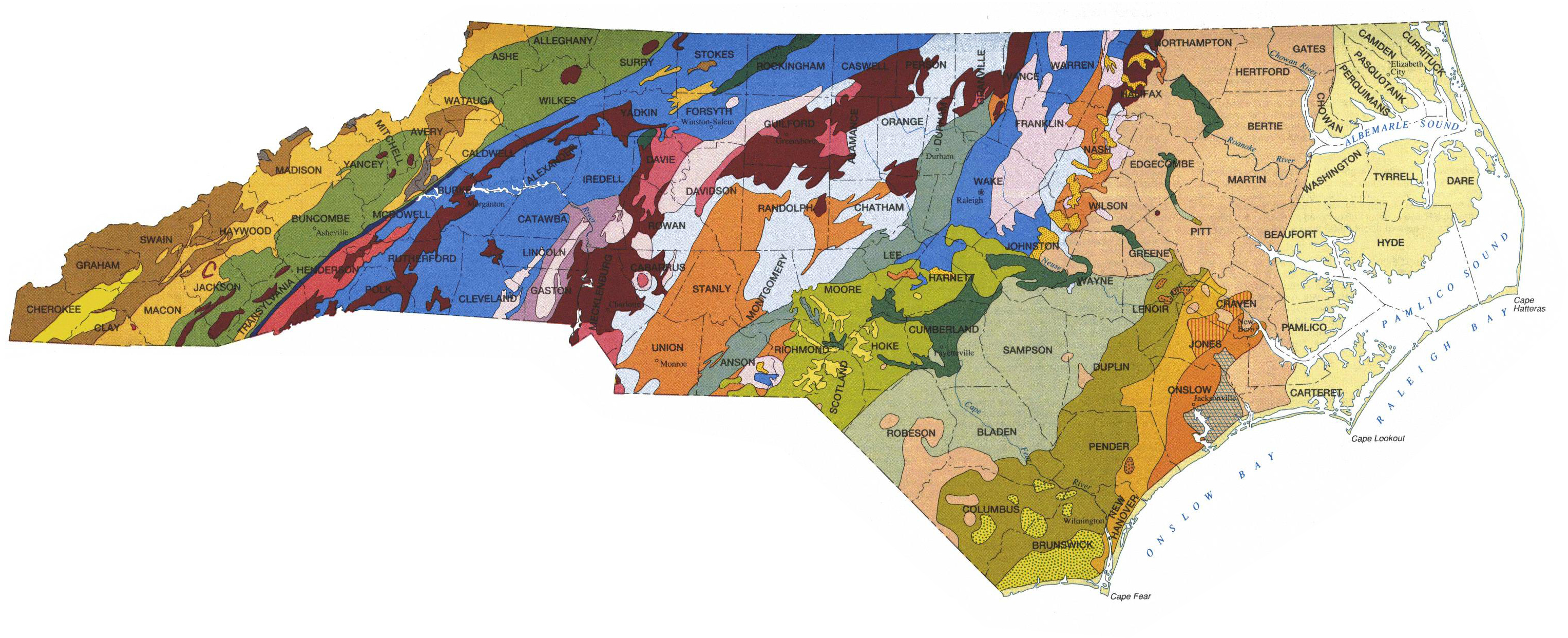
| Slide 67 - Geologic cross-section showing geologic
conditions in the debris flow initiation zone. The road failed in
a similar manner at this location about 20 years ago. |
Back to Top
 |
| Slide 68 - Debris flow scarps encroaching on a home
in McDowell County. Deep soil characteristic of weathered carbonate
rock of the Shady Dolomite is exposed in the scarps. Failure occurred
during Hurricane Frances. |
Back to Top
 |
Slide 69 - Honeycutt Mountain
Right: Arrow shows location
of home in previous slide built on steep slopes above an abandoned
quarry in the Shady Dolomite.
Left: May 10, 1954 aerial photograph
of area. Approximate location of the home in photo right indicated
by yellow square; red dashed line outlines past landslide deposits
in the quarry. |
Back to Top
 |
| Slide 70 - Honeycutt Mountain. Excerpt of 1985 geologic
map showing the location of the house in previous slide (yellow
arrow pointing to yellow dot). The Shady Dolomite, labeled Cs on
the map is of limited extent in N.C. |
Back to Top
 |
Slide 71 - Honeycutt Mountain. Left: Schematic cross
section showing slope failures in the deep, clayey soil overlying
a highly irregular weathering surface on the Shady Dolomite.
Right:
Leaning tree on the steep slopes below the house indicate unstable
slopes prior to the damaging slope failure during Hurricane Frances. |
Back to Top
 |
| Slide 72 - Catatoga Embankment Failure. Map showing
location of embankment failure that mobilized into a debris flow.
Failure occurred during Hurricane Frances. |
Back to Top
 |
| Slide 73 - Catatoga Embankment Failure. View looking
upslope at the initiation zone of the embankment that failed. Seepage
along a steeply sloping bedrock surface can be seen in both scars. |
Back to Top
 |
| Slide 74 - Debris dam in Indian Creek formed by the
Catatoga embankment failure-debris flow. |
Back to Top
 |
| Slide 75 - Blue Ridge Parkway. Failure occurred during
Hurricane Frances. Left and Right: Aerial photographs of the Bear
Drive Branch Creek embankment failure-debris flow originating along
the Blue Ridge Parkway between Mt. Mitchell and Linville. Slope
stability problems may not show up until many years after construction.
Bottom Center: Debris flow damage to U.S. Forest Service road and
bridge along Bear Drive Branch. |
Back to Top
 |
| Slide 76 - Photographs of ancient and modern debris
flow deposits below the Blue Ridge Parkway near Curtis Creek, Pisgah
National Forest, McDowell County. Top Center: An embankment failure
on the Blue Ridge Parkway during Hurricane Frances mobilized into
a debris flow and deposited boulders and large woody debris near
Curtis Creek. Bottom Left: Imbricated boulders deposited by a Hurricane
Frances debris flow (embankment failure) along the Blue Ridge Parkway.
Bottom Right: Ancient debris flow deposit with imbricated boulders
in the same stream channel as shown in bottom left photo. |
Back to Top
 |
| Slide 77 - Map showing track (red) of the Little Pine
Debris Flow in Madison County. The slope failure occurred during
Hurricane Ivan. |
Back to Top
 |
| Slide 78 - Little Pine Debris Flow. A. Apparent initiation
zone (road embankment) of Little Pine Debris Flow triggered by Hurricane
Ivan. B. View down track scoured by debris flow. C. Barn destroyed
by debris flow, out of view is a cabin damaged by the debris flow.
Red arrow points to person for scale. |
Back to Top
 |
| Slide 79 - Hebo Mountain. Failure occurred during
Hurricane Ivan. Left: Embankment failure that mobilized into a debris
flow. Rock baskets installed to reinforce the embankment appear
to have been placed on unstable foundation material. Right: Scarp
(indicated by red arrow) developing behind the main scarp and near
the house. |
Back to Top
 |
| Slide 80 - Starnes Cove Debris Flows. Coalescing debris
flow tracks shown in red. Failures occurred during Hurricane Ivan. |
Back to Top
 |
| Slide 81 - Starnes Cove Debris Flows. Right: View
looking up debris flow tracks toward logging road where the debris
flows appear to have originated. Left: View looking down debris
flow track, red arrow points to mud line in tree about 25 feet above
base of tree, and at least 30 feet above stream channel; geologist
at base of tree for scale. |
Back to Top
 |
| Slide 82 - House destroyed by the Starnes Cove debris
flow. Resident was in the house at the time and survived. The debris
flow also destroyed the garage of the house immediately downstream. |
Back to Top
 |
| Slide 83 - Home site embankment failure in the Peaks
at Lake Lure that mobilized into a debris flow during Hurricane
Ivan. Left: View looking upslope along track to initiation zone
(red arrow). Right: Logs and other woody debris within embankments
do not contribute to the long term stability of the embankment. |
Back to Top
 |
| Slide 84 - Upper track of Wayah debris flow 1 west
of Franklin in Macon County. This debris flow appears to have initiated
from naturally occurring conditions on a steep hillslope. Failure
occurred during Hurricane Ivan. |
Back to Top
 |
| Slide 85 - Lower track and deposit of Wayah Debris
Flow 1. The debris flow destroyed a barn that was located in front
of the house. The mud from the most recent debris flow was deposited
onto the floodplain of Wayah Creek. |
Back to Top
 |
| Slide 86 - Deposits from multiple ancient debris flow
and flood deposits are exposed in the recently eroded channel of
Wayah Debris Flow 1. Deposit 4 indicates large woody debris piled
behind the tree from the recent (Ivan) debris flow. |
Back to Top
 |
| Slide 87 - View of the Hurricane Ivan debris flow
track of Wayah Debris Flow 1 incised through prehistoric (?) debris
flow deposits forming a debris fan (top of fan indicated by red
dashed line) at the stream outlet. |
Back to Top
Contact Information
For additional information about landslide hazards in North
Carolina, please contact Mr. Richard Wooten with our Asheville Regional Office:
2090 U. S. Highway 70,
Swannanoa, North Carolina 28778.
828-296-4632
Rick.Wooten@ncdenr.gov
|