|
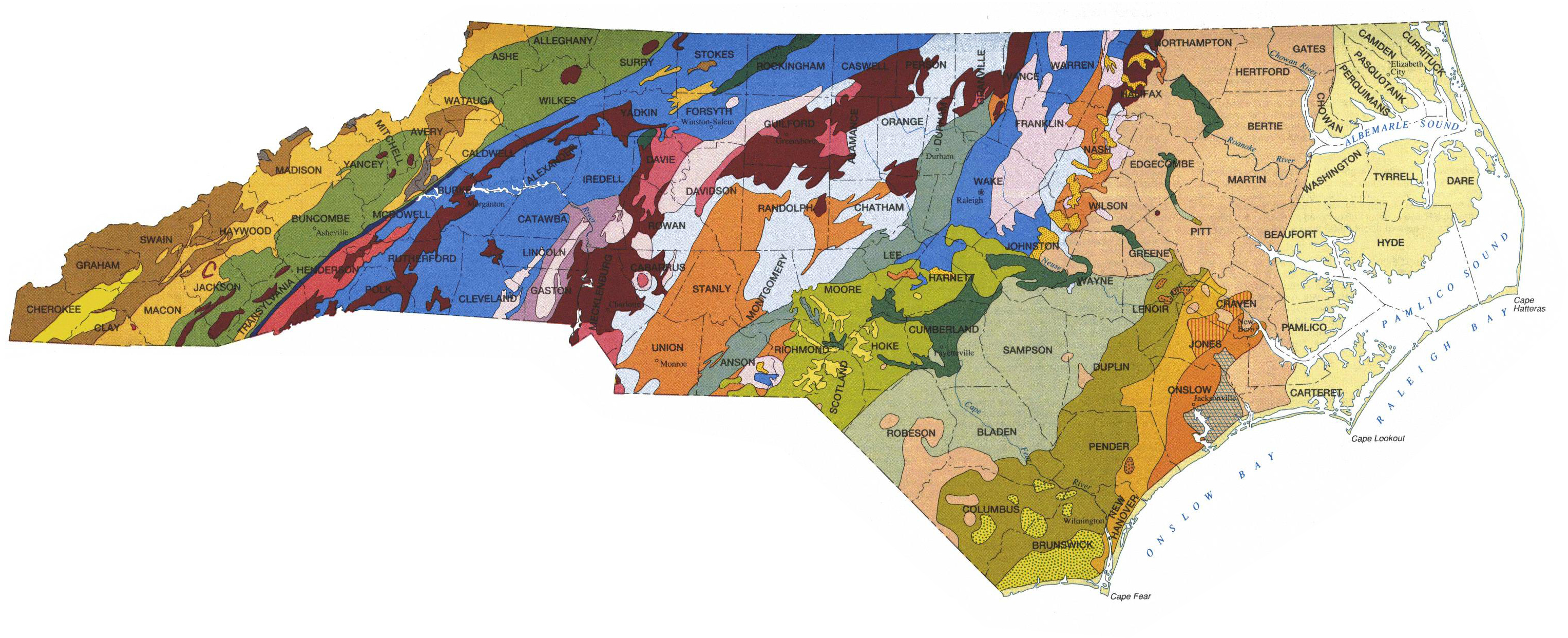
Some examples of landslide events in North Carolina are presented here. Scroll down for photographs, diagrams, and descriptions.
|
| Landslide Information On This Site:
|
Landslide presentation
The following images were included in a MS PowerPoint presentation
used by North Carolina Geological Survey geologists from the Asheville Regional Office at many public landslide outreach meetings. The presentation
has been adapted to the Internet for broader distribution. This page
is on "Rock Slope Stability." Links to other topics appear
in the contents shown above.
Slide numbers correspond to those of the original MS PowerPoint presentation.
Slide numbers "missing" are slides that were turned into text.
Captions are from the original presentation.
 |
Slide 30 - Landslides and landslide related fatalities
from the mid-July 1916 hurricane in Transylvania County, NC.
Damage from landslides and flooding occurred over much of the south-central
mountain area. The July 15-16, 1916 flood is considered the flood
of record in western North Carolina.
|
Back to Top
 |
| Slide 31 - Color-infrared aerial photograph of the
Gorges State Park area, Transylvania County, North Carolina showing mapped locations
of deposits left by the catastrophic failure of Lake Toxaway Dam
on August 13, 1916. The dam failure triggered a debris flow along
the Toxaway River that traveled over 7 miles and into South Carolina.
Lake Jocassee is underlain by cobble, gravel and sand deposits from
the flood. The original dam was in about the same location as the
current dam. The quote shown is from S.W. McCallie, State Geologist of Georgia
at the time. Studies by the North Carolina Geological Survey estimate that the outflow just below the dam was on the order of 293,938 cfs (discharge) and 50
mi/hr (velocity). Information from Geology of Gorges State Park,
N.C. Geological Survey Information Circular 31. |
Back to Top
 |
| Slide 32 - Top: View looking downstream along the
Toxaway River below the dam showing the assumed scour lines and
the location of cross section D (bottom) used to reconstruct the
super elevation angle of the dam failure torrent. This information
goes into computing an estimated velocity and discharge of the outflow.
|
Back to Top
 |
| Slide 33 - Top Left: 60-foot long boulder weighing
nearly 900 tons transported by the flood waters along the Toxaway
River from the August 13, 1916 Lake Toxaway Dam failure. Photograph
taken about 0.5 miles downstream from Toxaway Falls. Top Right.
Imbricated boulders at the crest of the boulder levee shown in red
in the cross section at Bottom Left. Bottom Right. Photograph of
the contact (shown by arrow) of the boulder flood deposits overlying
pre-existing flood plain deposits along the Toxaway River. |
Back to Top
 |
| Slide 34 - Left: Detailed map of a ~4 acre active
weathered-rock slide along the Toxaway River in Gorges State Park.
This slow-moving landslide was probably triggered by the 1916 dam
failure torrent that eroded and over-steepened the slope along the
river. Right: Tree ring studies of trees on and off the slide indicate
a period of slide movement during the 1965-1974 timeframe corresponding
to a period of above average rainfall. Tree ring studies were done
cooperatively with the U.S.F.S. Coweeta Hydrologic Laboratory, Otto,
N.C. Information contained in Geology of Gorges State Park, N.C.
Geological Survey Information Circular 31. |
Back to Top
 |
| Slide 35 - Trees growing on an active landslide are
commonly curved. The tree tilts with the moving slide, and over
time attempts to regain vertical growth resulting in the curved
trunk. A and B. Curved trees showing the effects of movement on
the Toxaway River weathered-rock slide. White arrow points to person
for scale in photo A (left). |
Back to Top
 |
| Slide 36 - Field developed cross section view of the
Toxaway River weathered-rock slide in Gorges State Park. Information
contained in Geology of Gorges State Park, N.C. Geological Survey
Information Circular 31. |
Back to Top
 |
Slide 37 - Left: Example of landslide hazard mapping.
Slope movements (landslides), flood and other surficial deposits
mapped in Gorges State Park by the N.C. Geological Survey.
Right:
Bedrock geologic map of Gorges State Park. Mapping landslides and
surficial units along with bedrock provides the best geologic framework
for constructing landslide hazard maps. Information contained in
Geology of Gorges State Park, N.C. Geological Survey Information
Circular 31.
Center: Schematic block diagram showing the relationships
between bedrock structure, streams, and slope movements for Gorges
State Park, Transylvania County, N.C. |
Back to Top
 |
Slide 38 - Bottom Left: Digital shaded relief map
of Watauga County, slopes greater than 30 degrees are shown in
red.
Bottom Right. Debris flows and debris slides (shown in red)
triggered by the Aug. 10-17, 1940 hurricane. Base map is a georegistered
Sept. 1940 aerial photograph of the Blue Ridge Escarpment area near
Deep Gap in Watauga County (unregistered photograph courtesy of
U.S.G.S.). Light colors in the main stream and river channels are
sediment from the debris flows and flooding. The flooding and landslides
from this event killed 26 people in North Carolina alone. At least
two fatalities resulted from a landslide along the Watauga River. |
Back to Top
 |
| Slide 39 - Boulders line the surface of a small debris
fan deposit in Watauga County believed to be deposited by a debris
flow triggered by one of the the August 1940 storms. A for sale
sign is posted on the tree for this property. |
Back to Top
 |
Slide 40 - Upper Right: Light Detecting and Ranging
(LiDAR) hillshade derived from elevation data from
the North Carolina floodplain mapping program greatly aids in landslide
hazard mapping. Hillshade image of the Seven Devils-Foscoe area along
the Watauga River southwest of Boone showing some debris fans and
colluvial deposits (indicated by red arrows).
Lower Left: Location within Watuaga County - 10 meter shaded DEM map shown. |
Back to Top
 |
| Slide 41 - The November 2-6, 1977 tropical depression
triggered flooding and landslides across western North Carolina.
The map shows the location of numerous debris flows triggered by
this storm (red) in the Bent Creek watershed near Asheville. |
Back to Top
 |
| Slide 42 - Map and charts showing location, velocity,
rainfall and soil data for the Lands Creek Debris Flow I. The velocity
of a debris flow can be estimated by determining the banking, or
super elevation, angle it makes as it rounds channel bends, the
radius of curvature of the channel, and the channel gradient. A
velocity of 23 mi/hr is about 33 ft/sec. Debris flows are particularly
dangerous because they often happen without warning and move very
rapidly downslope. The destroyed mobile home and chlorinator were
built on pre-existing debris fan and flood deposits. |
Back to Top
 |
Slide 43 - Upper Left: Initiation zone of the Dec.
23, 1990 Lands Creek Debris Flow I near Bryson City. Red arrow points
to person for scale standing above failed road embankment constructed
across a hillslope hollow. White dashed line shows profile of hillslope
hollow.
Bottom Right: Mud line in a tree left by the debris flow
next to new foundation pads for the chlorinator building for the
Bryson City municipal water system. The debris flow destroyed the
original chlorinator building. |
Back to Top
 |
Slide 44 - Left: Block diagram and cross section
views of initiation zone of the Lands Creek Debris Flow I, where
a private logging road crossed a hillslope hollow. Block diagram
illustrates a conceptual model of a hillslope hollow where the Lands
Creek debris flow began. Soil and groundwater accumulate in a subtle
hillslope depression overlying a concavity in the bedrock surface.
Right: Cross section shows approximate configuration of the road
profile and the underlying geology. The failure appears to have
occurred where the slope transitions from convex to concave. |
Back to Top
 |
| Slide 45 - Rainfall vs. elevation chart for rain gauge
stations in the region of the Lands Creek Debris Flow I. The elevation
of the initiation point for the Lands Creek debris flow is approximately
3000 ft. Rainfall amounts are generally greater at higher elevations
for a given storm event. Rainfall data courtesy of U.S.F.S. Coweeta
Hydrologic Laboratory and WHBN in Bryson City. |
Back to Top
 |
| Slide 46 - Rainfall intensity as much as rainfall
amount is as important in triggering debris flows. Graph shows plots
of 1 hr and 24 hr rainfall intensity readings from the U.S.F.S. Coweeta
Hydrologic Laboratory for the Nov. 2-6, 1977 storms and the Dec.
23, 1990 storm that triggered the Land Creek I debris flow. The
graph shows relative rainfall intensity and return periods for the
two events. Note that for the Dec. 1990 event the rainfall intensity
and return period is greater for the higher elevation rainfall gage
(Coweeta-31). |
Back to Top
 |
| Slide 47 - Views of the Lands Creek Debris Flow II
track and debris (left side of both images) that went into the Bryson
City reservoir. Reservoir was no longer a water supply source at
the time of the debris flow, and has since been drained (lower photo).
This debris flow originated from the same road as Lands Creek Debris
Flow I. |
Back to Top
 |
| Slide 48 - Hydrologic and rainfall data, radar map,
and map showing the locations of the Charley Branch debris flows
triggered by the 3-day rain event in Swain County in May 2003 that
caused extensive flooding and landslides. Rainfall and streamflow
data from U.S.G.S. Radar image from National Weather Service. |
Back to Top
 |
Slide 49 - Top: Cross section through the path of
the the Charley Branch 5 debris flow track showing the debris flow
superelevation angle and cross sectional area used to compute the
estimates of velocity and discharge.
Bottom Left: Track of CB5 debris
flow on CIR DOQQ base; track length is ~1000 ft.
Bottom Center:
Initiation zone of CB5 in road embankment. Red dashed line indicates
roadway.
Bottom Right: Mudline on tree from debris flow at point
A-15 on cross section. |
Back to Top
 |
Slide 50 - Left: Scarp in driveway embankment constructed
with excavated sulfidic-graphitic bedrock that failed and mobilized
into a debris flow during heavy rains in Swain County during May
5-7, 2003.
Upper Right: Tension crack in road embankment containing
a water line hook-up. Leaning trees (red arrow) indicate down slope
creep of the embankment material.
Bottom Right: Sulfidic-graphitic
bedrock with characteristic iron oxide stained weathering surface
and silver-gray fresh surface exposed in an excavation near home
in photo left. |
Back to Top
 |
| Slide 51 - This is a portion of the geologic
map of southwestern North Carolina (NCGS, 1992) near Bryson City
in Swain County. The red dots show locations of slope failures that
occurred with summer thunderstorms in May of 2003. From this perspective
it is hard to see any correlation between the slope failures that
coincide with areas underlain by sulfidic-graphitic bedrock. Studies
so far indicate that steep slopes underlain by sulfidic-graphitic
rock are more susceptible to landslides. |
Back to Top
 |
| Slide 52 - Generalized geologic map showing locations of debris
flows coinciding with areas underlain by sulfidic-graphitic bedrock.
Red dots indicate the number and dates of debris flows. Easternmost
debris flow is in sulfidic rock. Studies so far indicate that steep
slopes underlain by sulfidic-graphitic rock are more susceptible
to landslides. |
Back to Top
 |
| Slide 53 - Tracks of debris flows (yellow arrows)
triggered by Hurricane Opal, October, 1995 that damaged the Blue
Ridge Parkway northeast of Asheville. (1998 color-infrared image). |
Back to Top
 |
| Slide 54 - Color-infrared aerial photograph showing
reconnaissance map of debris fan, debris fan source areas, and alluvial
deposits in the Maggie Valley area, and locations of recent debris
flows. The 12/11/03 debris flow resulted in one fatality and a destroyed
house. |
Back to Top
 |
Slide 55 - Left: Green dashed line outlines debris fan with an
apartment complex; yellow dashed line outlines source area.
Right:
Schematic block diagram showing typical debris flow track and deposit.
Over thousands of years debris fans accumulate at the toes of slopes
from multiple debris flow and flood deposits. Debris fans are attractive
building sites because of moderate slopes above the main flood plains,
and the general lack of bedrock excavation required for roads and
foundations. Renewed debris flow activity originating in the source
area can put developments on debris fans at risk. |
Back to Top
 |
| Slide 56 - Prehistoric debris fan deposits near Maggie
Valley, N.C. Inset: Completely decomposed rock clasts suspended
in a silty sand soil matrix. |
Back to Top
 |
| Slide 57 - Steep, high excavations in debris fan deposits
can be unstable. This cut slope failed during the May 5-7, 2003
rains in Swain County. Although the log cabin remained intact, the
failed debris pushed it 3-5 feet off its foundation. |
Back to Top
 |
| Slide 58 - Demolished remains of a residence at the
location of a fatal debris flow on Dec. 11, 2003 near Maggie Valley.
Much of the demolition took place during the effort to rescue the
victim buried in the back of the house. The embankment failure that
originated in the scarp in the background mobilized into a debris
flow. A broken water supply line, the road embankment, and a buried
dark line marking the location the original ground surface can be
seen in the scarp. A lawsuit pending against the Maggie Valley Sanitary
District and the N.C. Department of Transportation claims that the
leaking waterline caused the embankment failure. At this time it
is not known if the water line was leaking, and if it was, what
caused the leak. |
Back to Top
Contact Information
For additional information about landslide hazards in North
Carolina, please contact Mr. Richard Wooten with our Asheville Regional Office:
2090 U. S. Highway 70,
Swannanoa, North Carolina 28778.
828-296-4632
Rick.Wooten@ncdenr.gov
|