|
Updated September 2005
This geoarcheology project was conducted to assist the Division of
Cultural Resources to determine the type and possible origin of foundation
stones located at the James Coffield House, 209 East King Street, Edenton,
North Carolina.
The original house was built around 1764. None of the original structure
remains visible today. Through the 19th and 20th centuries, there have
been numerous modifications to this house. During restoration in 1973
it was discovered that the oldest foundation consisted of blocks of
limestone. One of these blocks was recovered and serves as the basis
of this study.
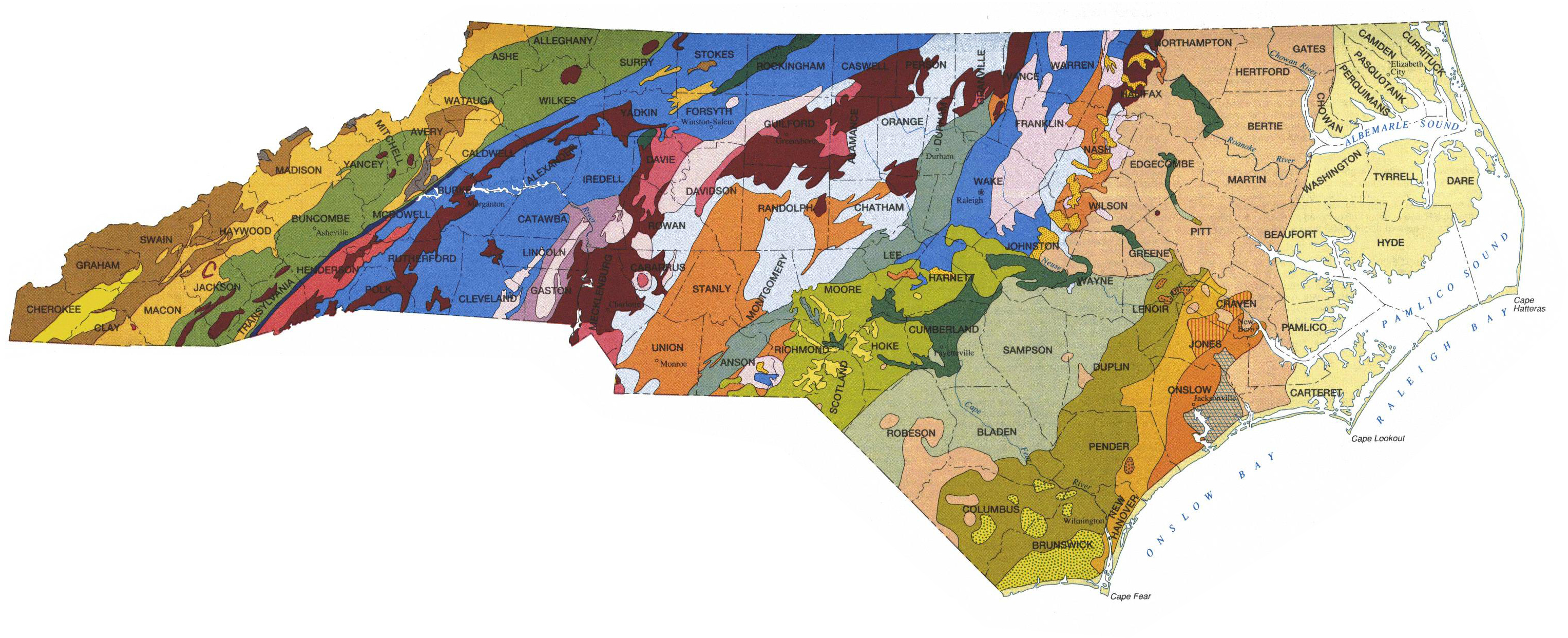
The foundation stones are limestone and it was concluded that the stones
origin was possibly the Bahamas. They were most likely transported to
North Carolina by trading ships circa 1700's.
Foundation rocks were identified using a hand lens followed by petrographic
thin section examination to confirm the rock type. This page summarizes
the findings of the study and presents a series of photomicrographs
of these rocks. This brief study was done in 2004 by Kenny Gay, staff geologist with the North Carolina Geological Survey. E-mail Kenny Here
 |
James Coffield House, 209
East King Street, Edenton, North Carolina. |
 |
Bedded and cross-bedded,
biosparite or biograinstone in foundation underneath house |
 |
Good general photomicrograph
showing characteristics of the foundation stones. These features
include micritized, skeletal,
carbonate sand grains, bioclasts, grain-contacts, and meniscus calcite
cement. Other features include isopachous bladed calcite cement partly surround some bioclasts,
a micrite envelope is filled with blocky calcite, and some of the
internal porosity in the bioclasts is filled with blocky calcite.
Magnified 10x |
 |
Bryozoan bioclast, zooecia, are partly
filled with bladed calcite cement. The right side of photo shows
grain-contacts,
meniscus calcite cement, and isopachous bladed calcite cement.
Magnified 10x |
 |
Coral bioclast, the intergranular porosity
is partly filled with blocky calcite cement. Magnified 10x |
 |
Benthonic foram. The intergranular porosity
is partly and completely filled with blocky calcite cement.
Magnified 10x |
 |
Isopachous bladed calcite cement surrounding
an oolith. Also, bioclasts, are showing grain-contacts, meniscus calcite
cement, and some intergranular porosity is partly and completely
filled with blocky calcite cement. Magnified 10x |
 |
Rounded, micritized, bioclast
showing grain-contacts, meniscus calcite cement. Also, isopachous
bladed calcite cement partly surrounding some of the bioclasts.
The
boring in the upper left is partly filled with bladed calcite cement.
Magnified 20x |
 |
Micrite envelope. A micrite envelope
is formed when the original clast has been removed by solution leaving
the outer-most rim of the clast behind. Magnified 10x |
 |
An oolith showing grain-contact, meniscus
calcite cement. Magnified 10x |
 |
An intraclast of micritized oolites or pellets. The intergranular
porosity is partly filled with blocky calcite cement. Magnified 10x
|
 |
Bioclasts of red algae,
a worm tube, and other micritized clasts are cemented by grain-contact,
meniscus calcite cement. Also, the intergranular porosity is partly
to completely filled with blocky calcite cement. Magnified 10x |
Contact information
Kenny Gay
North Carolina Geological Survey
1620 Mail Service Center
Raleigh, NC 27699-1620
919-733-7353, ext. 28
kenny.gay@ncmail.net.
Additional information about the James Coffield House is located in,
"Edenton An Architectural Portrait," by Thomas R. Butchko,
1992, pages 201-202. The report was published by the Edenton Woman's
Club and Chowan County Government, Edenton, North Carolina. The Library
of Congress Catalog Card Number is 92-90186.
|