| Dimension stone (building stone) in North Carolina | ||
Dimension stone (granite)
overview
Marble
|
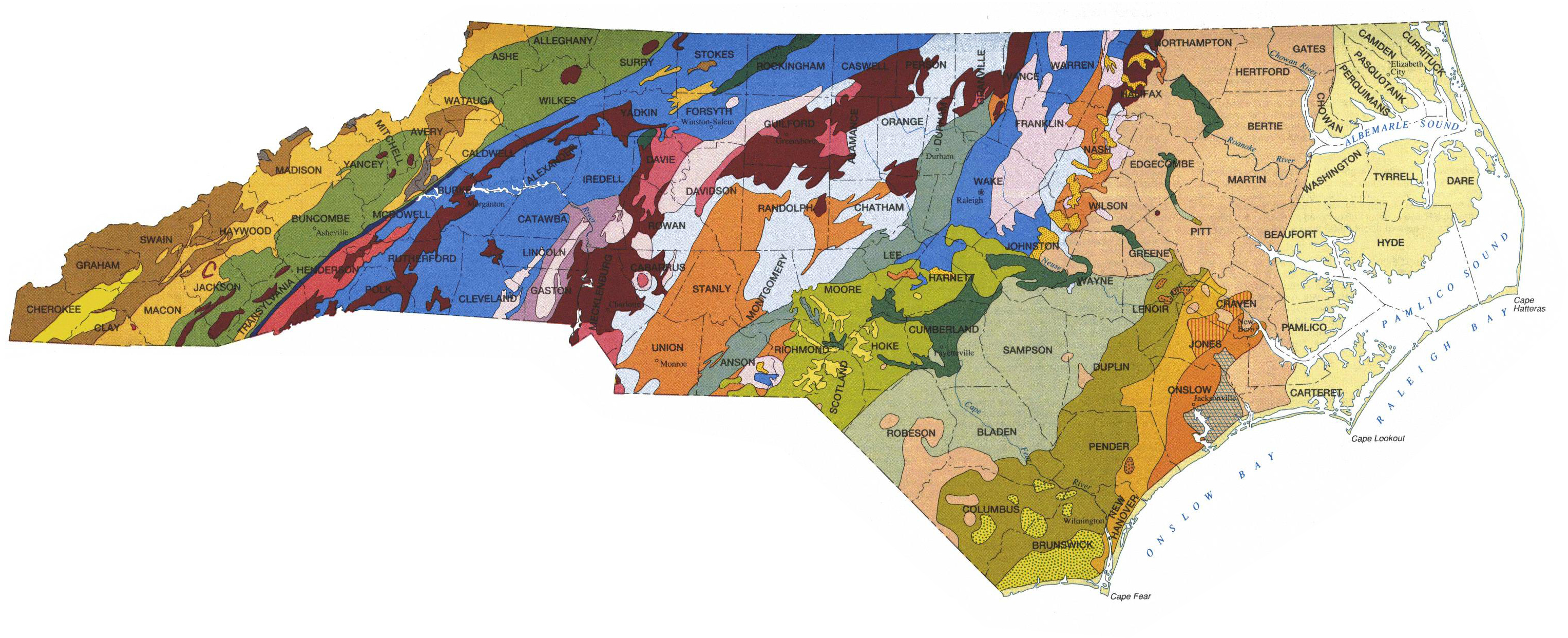
![]() Courtesy North Carolina Granite Corp.-- This is a view of the Mt. Airy dimension stone quarry that is located near Mt. Airy, Surry County, North Carolina. Shown here are many of the elements of a dimension stone quarry. Granitic material is being mined. The active mining area is at the right part of the image. Some of the buildings where blocks of dimension stone are cut and shaped are shown in the left part of the image. Some quarried blocks are shipped directly from the mine face. Most of these quarried blocks are transported by container ship overseas to the far east and to other world markets. This quarry has been in continuous operations for over 100 years. Granite is the official State Rock of North Carolina. The purpose of these pages is to show the color and texture of building stones in North Carolina, and how they are produced. In 2000, North Carolina ranked tenth in the United States in dimension stone production. Nearly 40,500 metric tons of dimension stone were produced with a value of about $5,780,000. The four major types of dimension stone now produced in North Carolina are: 'granite,' argillite, flagstone and marble. Dimension stone is produced from limited geographic areas in North Carolina. Click here for a map showing permitted active and inactive dimension stone mines in North Carolina without a geologic map base. Click here for a map showing permitted active and inactive dimension stone mines in North Carolina on a geologic map base. Contact information for individual producers is available in MS Excel format, and tab delimited ASCII text. The contact information was current as of January, 2002. The Education Subcommittee of the N.C. Mining Commission provided funding for field work and photographic processing to Jeffrey C. Reid, Principle Investigator. Their assistance is very much appreciated. Jacobs Creek Stone Co., Inc. (Denton, N.C.), North Carolina Granite Corporation (Mt. Airy, N.C.), Carolina Quarries (a Division of Rock of Ages Corp.), and Rockwell Granite (the latter two both of Salisbury, N.C., were gracious to permit entry and for permission to photograph their operations. Some flagstone product images were obtained from Vengeance Creek Stone Company's Internet site; the company is located in Murphy, N.C. Dimension stone can be defined as natural
rock material quarried for the purpose of obtaining blocks or slabs that
meet specifications as to size (width, length, and thickness) and shape.
Color, grain texture and pattern, and surface finish of the stone are
normal requirements. Durability (essentially based on mineral composition
and hardness and past performance), strength, and the ability of the stone
to take a polish are other important selection criteria. Dimension stone is used extensively in home improvements, historic preservation, exterior and interior paneling for buildings and construction applications. Most dimension stone was sold or used as rough blocks for building and construction, flagstone, curbing, ashlars and partially squared pieces, and monumental and memorial stones in 2000. Dimension stone is sold as rough stone, primarily used in construction. Dressed stone represented 45% by tonnage and 54% by value of the total stone sold or used in 2000 according to the U.S. Geological Survey. The largest uses of dressed stone, by tonnage, were in flagging (28%), ashlars and partially squared pieces (20%), and curbing (10%). North Carolina is ranked tenth among dimension stone producing states in the U.S. Dimension stone is produced from thirty-six active and inactive quarries in the western part of North Carolina. The average production life of a dimension stone quarry is measured in decades or longer. Flagstone operations may be short lived. Mt. Airy (granite) and Jacob's Creek (meta-argillite) are the only dimension stone operations in North Carolina that integrate quarrying and rock dressing on site. They produce a wide variety of products. Other North Carolina dimension stone operations produce blocks of stone destined for overseas markets. The dimension stone industry in North Carolina employs several hundred people. The number of employees at a dimension stone operation ranges from two or three to as many as 170. The average number employed at any one operation is probably about 10-20 people. Most dimension stone is moved by truck. A large proportion of dimension stone is shipped overseas by ocean transport. Because dimension stone is a heavy, moderate to high cost per ton product, it can be transported considerable distance. Truck haul costs approximately 15 to 20 cents per ton-mile. Because of the value of North Carolina dimension stone -- especially 'granite' and to the low cost of ocean transportation, a significant proportion of dimension stone is transported overseas by ship for cutting and finishing. Until recent years dimension stone blocks were shipped unprotected in cargo holds. Now, because of balance of payments and the excess supply of containers, virtually all dimension stone shipped overseas is loaded into individual containers for shipment to markets in China and elsewhere. The
North Carolina Mining Act, passed in 1971, and its regulations require any
dimension stone mining operation of one acre or more to apply for and
receive a North Carolina mining permit. The permit is issued for 10 years,
but can be withdrawn if all requirements of the permit are not complied
with. Many other local and state permits and environmental regulations
control the operation of dimension stone plants. All sites must be
reclaimed before the reclamation bond will be released at the conclusion
of mining. Once
reclaimed, dimension stone quarries are desirable as water reservoirs or
recreational lakes, often with residential subdivisions nearby. Wetlands
are often created as a result of mining. The industry is very sensitive to
and responsive to its need to be a good steward of the environment and a
good neighbor in the community. While there is a large reserve of dimension stone worldwide, high quality accessible dimension stone with color, texture, mineralogy, strength and other factors is more limited. A ready supply of dimension stone is necessary for many architecture needs. The big concern facing the dimension stone industry in coming years is obtaining zoning favorable for the extraction of dimension stone. It is most important to allow appropriate zoning and the necessary permits to assure a continued supply of dimension stone. According
to the U.S. Geological Survey the average 2000 value for dimension stone
was $188 per metric ton. The average unit values for different types of
dimension stone were granite, $270 per ton; limestone, $151 per ton;
sandstone, $100 per ton; marble $228 per ton, and slate $495 per ton.
Prices are substantially different not only for the kind of stone but also
for the appearance of the same kind of stone. Color, grain structure, and
finish contribute significantly to price and marketability. |